
Login to like or dislike this topic.
Dua for Umrah Niyyah: The Correct Formula & Step-by-Step Ihram Guide | Al-Jiwar Platform
Table of Contents
- 1. Introduction: The Spiritual Journey to the Sacred House
- 2. What is Umrah Niyyah? Is Uttering It Mandatory or Recommended?
- 3. The Correct Dua for Umrah Niyyah from the Sunnah
- 4. "Stipulation in Ihram" (Ishtirat): When to Say It and Its Ruling
- 5. Sunnah Preparations Before Ihram (Practical Steps)
- 6. The Miqats (Boundaries): Where to Start Your Ihram
- 7. How to Enter Ihram Onboard an Airplane Step-by-Step
- 8. Specific Rules & Guidelines for Women's Ihram
- 9. Prohibitions of Ihram & Fidyah (Compensations)
- 10. Complete Umrah Rituals: Tawaf, Sa'i, and Tahallul
- 11. Recommended Supplications During Tawaf and Sa'i
- 12. Common Mistakes Pilgrims Make During Niyyah & Ihram
- 13. Frequently Asked Questions (FAQ)
- 14. Special Opportunity: Win a Free Umrah Trip with Al-Jiwar
1. Introduction: The Spiritual Journey to the Sacred House
Umrah remains one of the purest acts of worship that cleanses the soul and renews faith. It is a spiritual journey wherein a Muslim leaves behind worldly distractions and daily stressors to answer the divine call, seeking mercy and forgiveness, hoping to return as pure as the day they were born.
Because "Ihram" is the first pillar of Umrah and its main gateway, understanding how to enter the state of consecration and reciting the correct Dua for Umrah Niyyah (intention) is a critical step for every pilgrim. The validity of worship is intrinsically linked to following the Sunnah of Prophet Muhammad (peace be upon him). In this comprehensive reference guide from Al-Jiwar Platform, we walk you step-by-step through the intention, Miqat preparations, flight-based Ihram, and completing all Umrah rituals smoothly and authentically.
2. What is Umrah Niyyah? Is Uttering It Mandatory or Recommended?
Linguistically, Niyyah means intention and resolve. In Islamic terminology, it is the firm resolve in the heart to enter the sacred state of Ihram for Allah's sake. Intention distinguishes habit from act of worship, and without it, Umrah is invalid.
Is the Intention Made in the Heart or Spoken Aloud?
There is an important Islamic jurisprudence detail regarding Hajj and Umrah that differs from other acts of worship:
- General Rule for Acts of Worship: The location of intention is strictly in the heart. It is not prescribed to utter it aloud in prayer, fasting, or Zakat.
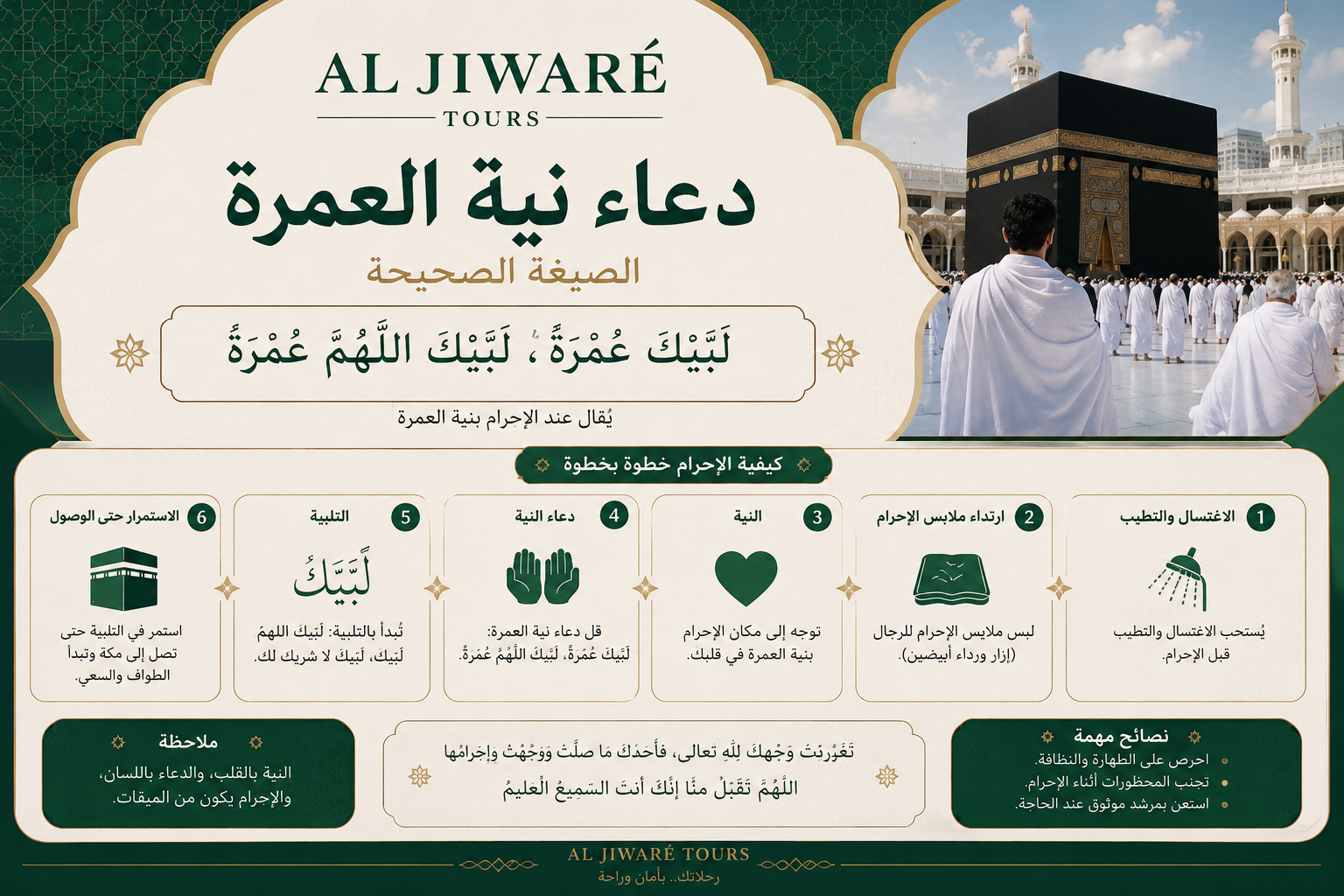
- Exception in Hajj & Umrah: It is Sunnah upon reaching the Miqat (or its alignment) to verbally pronounce entering the ritual after resolving in the heart by saying audible words: "Labbayka Allahumma Umrah". Verbalizing this is equivalent to the opening Takbir in prayer, prohibiting acts that were previously lawful.
Once you make this resolve and utter the Talbiyah, all rulings of Ihram apply to you immediately.
3. The Correct Dua for Umrah Niyyah from the Sunnah
Several authentic formulas have been transmitted from the Prophetic tradition for making the intention when entering Ihram. Pilgrims may choose based on their preference or circumstances.
The Direct & Primary Formula (Preferred):
«Labbayka Allahumma Umrah»
(Here I am, O Allah, making 'Umrah)
Formula Requesting Ease and Acceptance:
«Allahumma Innee Ureedul-Umrata Fa-Yassirhaa Lee Wa Taqabbalhaa Minnee»
(O Allah, I intend to perform Umrah, so make it easy for me and accept it from me)
Continuous Talbiyah After Niyyah:
Immediately after making Niyyah, the pilgrim begins reciting the Talbiyah continuously until starting Tawaf around the Kaaba (recited aloud by men and quietly by women):
«Labbayk Allahumma Labbayk, Labbayka Laa Shareeka Laka Labbayk, Innal-Hamda Wan-Ni'mata Laka Wal-Mulk, Laa Shareeka Lak»
4. "Stipulation in Ihram" (Ishtirat): When to Say It and Its Ruling
Islamic Sharia is characterized by mercy and flexibility. One aspect of this ease is "Ishtirat" (making a condition during Ihram), protecting the pilgrim if an unforeseen emergency prevents completion of Umrah.
When Should You Make Ishtirat?
It is Sunnah to state a condition if a pilgrim fears an impediment, such as severe illness, old age, fear of menstruation for women, or flight/transportation disruptions.
The Dua for Ishtirat:
The pilgrim adds right after making intention:
«Allahumma Mahillee Haithu Habastanee»
(O Allah, my place of exit from Ihram shall be wherever You prevent me)
The Great Jurisprudential Benefit:
If a pilgrim makes this stipulation and is genuinely prevented from reaching Makkah, they may exit Ihram immediately by changing into normal clothes without owing a penalty (sacrificing a sheep) or needing an immediate makeup Umrah.
5. Sunnah Preparations Before Ihram (Practical Steps)
Before reciting the Niyyah and entering the state of prohibition, perform these Sunnah preparation steps:
- Personal Hygiene & Fitrah Acts: Trim fingernails and toenails, trim the mustache, and remove underarm and pubic hair.
- Ghusl (Ritual Bath): Performing Ghusl is highly recommended for everyone, including men, women, children, and menstruating women.
- Applying Attar/Perfume (Men Only): Men are advised to apply perfume or Oud onto their body, beard, and head before declaring intention. Note: Perfume must NOT touch the Ihram garments.
- Wearing Ihram Attire:
- For Men: Consists of two unstitched white sheets: the Izar (waist wrapper) and Rida' (upper garment), along with unstitched footwear exposing ankle bones.
- For Women: Normal modest, loose-fitting Islamic clothing covering the entire body except face and hands. No specific color is mandatory.
6. The Miqats (Boundaries): Where to Start Your Ihram
Miqats are geographical boundaries designated by Prophet Muhammad (PBUH) beyond which no pilgrim traveling to Makkah for Umrah or Hajj may pass without being in Ihram.
7. How to Enter Ihram Onboard an Airplane Step-by-Step
With air travel being the primary means for overseas pilgrims, here is the exact timeline for airborne Ihram:
Flight Ihram Procedure:
- Pre-Flight Preparation: Perform Ghusl at home or in airport facilities. Put on your Ihram garments before boarding (or on board before reaching Miqat). Do NOT recite Niyyah yet.
- In-Flight Announcement: Flight captains usually announce Miqat alignment 15–20 minutes prior.
- Reciting Intention & Talbiyah: Upon alignment announcement, remove head coverings (men), declare Niyyah verbally: «Labbayka Allahumma Umrah», and begin reciting Talbiyah continuous.
8. Specific Rules & Guidelines for Women's Ihram
Women have tailored rules ensuring modesty and comfort during Umrah:
- Attire: Any modest, loose-fitting clothing hiding body contours is allowed. No specific colors are required.
- Prohibited Garments: Women in Ihram must NOT wear a Niqab (fitted face veil with eye slits) or Gloves. She may draw her headscarf loosely over her face when passing non-mahram men.
- Talbiyah: Recited softly so only she (and adjacent companions) can hear.
- Menstruating Women: A woman experiencing menstruation performs Ghusl, wears Ihram attire, and pronounces Niyyah at Miqat. She recites Dhikr and Talbiyah, but must NOT perform Tawaf or Sa'i until she becomes pure and performs Ghusl.
9. Prohibitions of Ihram & Fidyah (Compensations)
Once Niyyah is recited, the pilgrim enters a state of consecration where specific actions become strictly forbidden:
1. General Prohibitions (Men & Women):
- Cutting hair or shaving any body hair.
- Trimming fingernails or toenails.
- Applying perfume or scented soap/shampoo.
- Marriage contracts or proposals.
- Sexual relations or intimate physical contact.
- Hunting land animals.
2. Men-Only Prohibitions:
- Covering the head with form-fitting caps, turbans, or hoods (umbrellas/sunshades are permitted).
- Wearing stitched garments tailored to fit limbs (e.g., shirts, trousers, underwear, socks).
3. Women-Only Prohibitions:
- Wearing a fitted Niqab or gloves.
Fidyah (Penalty) Ruling: Accidental or forgetful violations carry no penalty. Necessary violations due to medical reasons require Fidyah: choice of 3 days fasting, feeding 6 poor persons, or sacrificing a sheep.
10. Complete Umrah Rituals: Tawaf, Sa'i, and Tahallul
Step 1: Tawaf Around the Kaaba
Enter Al-Masjid Al-Haram with your right foot saying: «Allahumma-ftah lee abwaaba rahmatik». Perform 7 counter-clockwise circuits starting and ending at the Black Stone (Hajar al-Aswad).
- Idtiba' (Men only): Uncover the right shoulder during Tawaf circuits.
- Raml (Men only): Brisk walking during the first 3 circuits.
Step 2: Two Raka'at of Tawaf
Cover right shoulder, then pray 2 light Raka'at behind Maqam Ibrahim (or anywhere in the mosque).
Step 3: Sa'i Between Safa and Marwah
Perform 7 laps between Mount Safa and Mount Marwah, beginning at Safa and finishing at Marwah.
Step 4: Tahallul (Exiting Ihram)
- Men: Shaving the head completely (preferred) or trimming hair equally across the head.
- Women: Cutting a fingertip's length (approx. 1-2 cm) from the ends of her hair.
11. Recommended Supplications During Tawaf and Sa'i
While pilgrims can make any personal Dua, specific Sunnah supplications are highlighted below:
Dua Between Yemeni Corner & Black Stone:
«Rabbana Atina Fid-Dunya Hasanatan Wa Fil-Akhirati Hasanatan Wa Qina 'Adhaban-Nar»
Dua Upon Mounting Safa and Marwah:
«La Ilaha Illallahu Wahdahu La Shareeka Lah, Lahul-Mulku Wa Lahul-Hamdu Wa Huwa 'Ala Kulli Shay'in Qadeer»
12. Common Mistakes Pilgrims Make During Niyyah & Ihram
- Passing Miqat Without Ihram: Waiting until landing at Jeddah airport before putting on Ihram.
- Uncovering Right Shoulder Continuously: Uncovering shoulder (Idtiba') is Sunnah during Tawaf ONLY, not for entire journey.
- Believing Ihram Garments Cannot Be Changed: Pilgrims may wash or swap Ihram towels anytime.
13. Frequently Asked Questions (FAQ)
Q1: Can I wear footwear with stitching during Ihram?
A: Yes. "Unstitched" applies to garments tailored to body shapes (pants, shirts). Sandals with stitched straps are completely permissible provided ankles remain exposed.
Q2: What if I forgot to utter the Niyyah aloud at Miqat?
A: As long as intention was firmly established in your heart upon crossing Miqat, your Umrah is valid. Verbalizing is Sunnah, not a pillar.
14. Special Opportunity: Win a Free Umrah Trip with Al-Jiwar
At Al-Jiwar Platform, we strive to enrich the spiritual journey of pilgrims through comprehensive guidance and community rewards.
Did you know you can plan your trip and enter periodic draws to win an all-inclusive FREE Umrah package or valuable rewards?
Earn loyalty points by utilizing certified services, joining educational modules, or referring friends and family to Al-Jiwar.
May Allah accept your rituals and bless your journey. Keep us in your prayers at the Holy House!
Comments (0)
Login to comment on topics.
RegisterNo comments yet.