
Login to like or dislike this topic.
The Ultimate Comprehensive Guide to Saudi Transit Umrah & Stopover Visa in 2026: Digital Planning Secrets, Jurisprudence Rules, and Navigating Crucial Transport & Accommodation Logistics 2026
Global attention is highly focused in 2026 on the unprecedented digital facilities provided by the Kingdom of Saudi Arabia for the guests of Allah, specifically within the framework of Saudi Vision 2030, which is moving at an accelerated pace to host 30 million Umrah pilgrims. Among the most prominent of these revolutionary facilities that have reshaped the map of religious tourism is the Electronic Transit Visa for air arrivals, popularly known as "Transit Umrah" or "Saudi Stopover Visa".
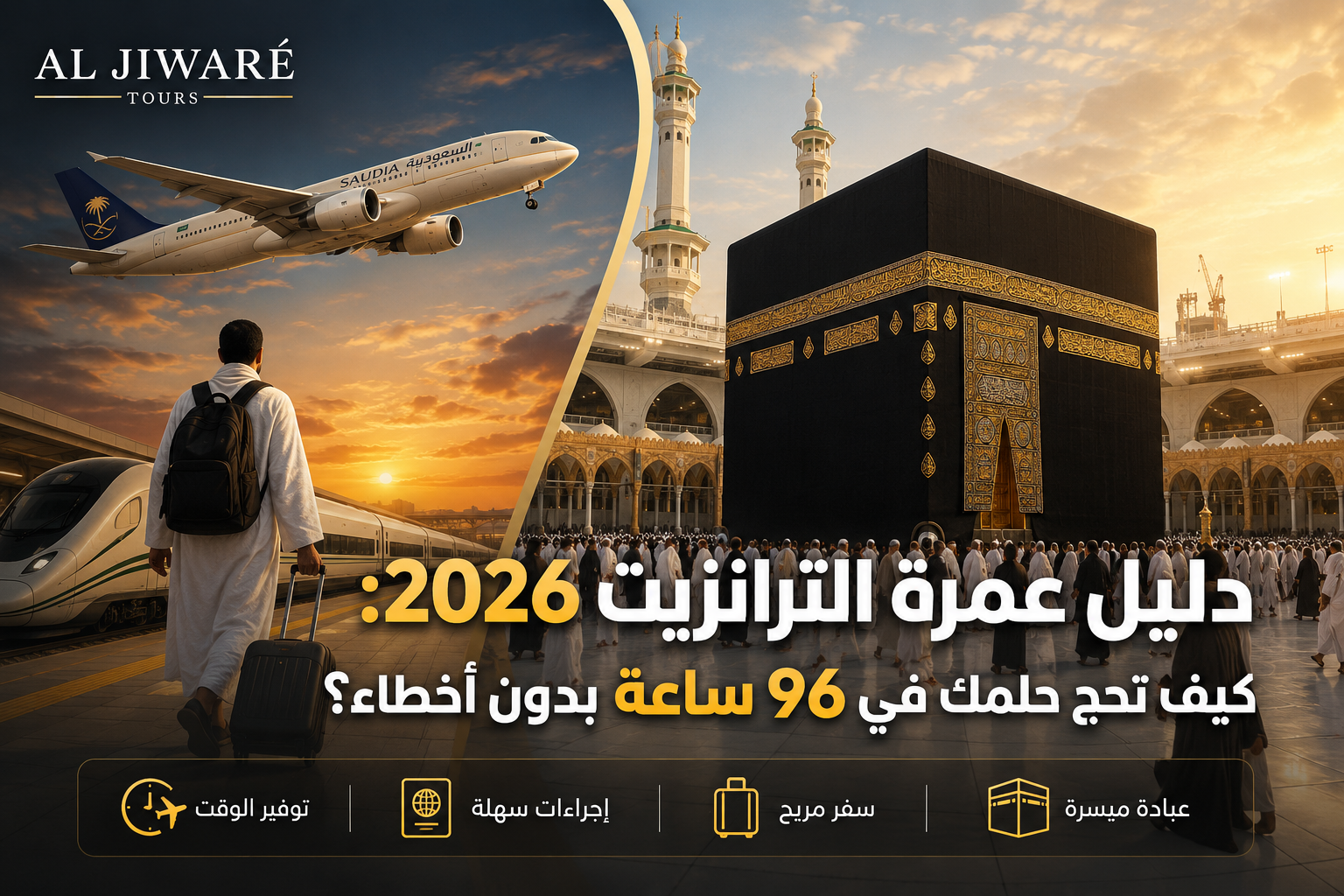
This visa is not just a passing administrative procedure; it is a unique spiritual bridge connecting passengers flying through Saudi airspace to the Holy House of Allah and the Prophet’s Holy Mosque at the lowest possible cost and in the fastest time. However, the short duration of the visa (96 hours only) makes it a double-edged sword in 2026. It can either be a seamless, perfectly organized spiritual journey or turn into a vortex of confusion and doubled expenses due to simple logistical errors in estimating distances, calculating transportation time, or ignorance of the jurisprudence rules related to Ihram from the airplane.
In this expanded and comprehensive guide, which we present as the definitive first reference on the internet for 2026, we will dive into all aspects of Transit Umrah: the technical conditions, the logistical traps that pilgrims fall into, the aerial Miqats (boundary points), and the exact transport and accommodation details step-by-step to guarantee an ideal spiritual journey.
Section 1: Detailed Overview of the Saudi Transit (Stopover) Visa in 2026
1. What is the Transit Visa for Air Arrivals?
The Transit Visa is an electronic entry visa granted by the Ministry of Foreign Affairs in coordination with the General Authority for Civil Aviation and Saudi national carriers (Saudi Arabian Airlines and Flynas) for passengers who have a stopover at one of the Kingdom's airports before heading to their final international destination.
This technical system is integrated directly with flight booking platforms. This allows travelers to issue both the visa and the flight ticket simultaneously, completely eliminating the need to visit embassies or diplomatic offices.
2. Spiritual and Economic Advantages of the Visa
- Free of Base Visa Fees: The visa is unique because its base fees are entirely free when purchasing the airline ticket. Travelers only pay simple electronic administrative and medical insurance fees during the booking process, compared to the high costs of a traditional Umrah or tourist visa.
- Instant Simultaneous Issuance: There is no need to wait for days or weeks. The visa is issued digitally and instantly, embedded directly within your airline ticket documents in a matter of minutes.
- Geographical and Logistical Flexibility: The visa allows you total freedom of movement between different regions of the Kingdom. You can land at King Abdulaziz International Airport in Jeddah, travel to Makkah to perform Umrah, take the high-speed train to Madinah, and depart from Prince Mohammad bin Aziz Airport in Madinah—or vice versa—as long as the flights fall within the hosting national carrier’s network.
- Validity and Duration of Stay: The visa remains valid for 90 days from its date of issuance, which gives you excellent flexibility to choose the perfect time to travel. It grants an actual physical stay inside the Kingdom for up to 4 full days (96 hours) from the moment your passport is stamped at immigration.
Section 2: Legal and Technical Requirements Imposed by the Saudi Ministry of Foreign Affairs
To ensure your application is approved through the digital systems in 2026 without any rejection or delay, you must strictly meet the following technical and legal requirements:
1. Personal Travel Document Conditions
- Passport Validity: The passport validity must not be less than 6 months from the expected date of entering the Kingdom. Integrated electronic systems automatically reject passports with less validity, and this condition cannot be bypassed with fees or exceptions.
- Final Destination Visa: The traveler must possess valid travel documents and a current entry visa (if required) for the country they are heading to after leaving Saudi Arabia (the third destination). For example, if you are traveling from Cairo to London via Jeddah, the UK visa must be stamped on your passport or held electronically to prove to the systems that you are a genuine transit passenger and not planning an illegal stay.
2. Flight Booking and Structural Constraints
- Exclusivity of National Saudi Carriers: You cannot benefit from this visa if you book your flight on a non-Saudi airline (such as EgyptAir, Emirates, Turkish Airlines, etc.). The visa is technically and exclusively integrated only with the booking systems of Saudi Arabian Airlines (Saudia) and Flynas.
- Nature of the Booking (Connected Ticket): The booking must be a single connected ticket (under one Passenger Name Record - PNR) that includes the origin destination, the stopover station in Saudi Arabia, and the final destination. The systems do not accept separate tickets booked through different companies or fragmented bookings.
Section 3: The Logistical Trap: The Common Mistake That Destroys a 96-Hour Journey
This is the most critical section that every pilgrim planning a Transit Umrah must absorb and deeply understand. Hundreds of pilgrims fall daily into a fatal calculation mistake due to a "misunderstanding of geography, transport calculations, and airport processing times."
1. The Misconception and the Illusionary Scenario
Many travelers believe that performing Umrah via transit ends as soon as the free visa is issued and the flight ticket is booked. The pilgrim imagines that upon arriving at King Abdulaziz International Airport in Jeddah, the Holy Mosque of Makkah will be just a few steps away, or they think that moving around is a simple, random matter that can be managed on the spot without prior planning. They completely forget that the distance between Jeddah and Makkah exceeds 80 kilometers, and that the airport terminals are massive, requiring significant time to finalize immigration procedures and exit.
2. The Logistical Disaster and Doubled Expenses Scenario
Let us look at a real, recurring scenario of an unprepared pilgrim:
- Arrival and Disorientation at the Airport: The pilgrim arrives at the airport terminal (whether the new Terminal 1 or the Hajj Terminal) and spends about one to two hours clearing passports, customs, and reclaiming baggage. This duration increases significantly during peak seasons like Ramadan or the holy months of Rajab and Sha'ban.
- Chaos of Finding Transport and Driver Exploitation: The pilgrim exits to the outer airport courtyard without a pre-booked transport, only to be shocked by thousands of travelers and massive crowding. Here, they fall as a direct prey to unauthorized drivers or random taxis who exploit the exhausted pilgrim's urgent need and lack of knowledge about official rates, demanding exorbitant amounts that exceed multiples of the real price for a ride to Makkah.
- Random Housing Crisis and Distance from the Haram: Upon reaching Makkah, the pilgrim discovers they haven't booked a hotel that precisely fits the short transit hours, or they booked a cheap hotel that is very far in areas like Al-Aziziyah, Bathaa Quraish, or Al-Nozha without considering how to get to and from the Haram. The pilgrim wastes long, precious hours of their short time (which does not exceed 96 hours) waiting for public transport buses or searching for a taxi to take them from the hotel to the Haram to perform Umrah, and vice versa.
- The Return Journey Catastrophe and Missing the International Flight: The biggest and most terrifying trap happens on the return journey. The pilgrim forgets to calculate peak hours, the massive congestion at Makkah's exits, and security checkpoints. They fail to arrange a car or book a train back to Jeddah airport in advance. They begin searching for a taxi on the streets of Makkah just two or three hours before their international flight, only to find traffic completely gridlocked or no cars accepting the remaining cash they have. This ultimately leads to a critical delay causing them to miss their international flight (No Show).
- The Catastrophic Financial and Psychological Result: The primary flight to the final destination (such as America, Europe, or Asia) is lost. The pilgrim is forced to pay heavy flight modification fines, buy new tickets out of their own pocket, and bear the expenses of an extra hotel stay completely outside their budget. This is not to mention the severe psychological and physical exhaustion that entirely ruins the spirituality of Umrah and turns blessed moments into a real crisis. All of this happened just because they believed Transit Umrah does not require pre-arranging transport and accommodation!
3. How to Escape This Trap? (The Smart Solution We Provided For You)
To avoid all this chaos and ensure your budget and valuable time are not lost in airport corridors or the streets of Makkah, the absolute solution depends on prior planning and booking your services with trusted entities before your plane takes off.
Therefore, to protect you from the greed of random drivers and ensure your smooth movement, we have provided an integrated network of certified and reliable service providers in this field for 2026. We have designed digital tools and direct solutions for you that allow you to organize your spiritual journey yourself with absolute professionalism:
- Flexible Individual Trip Design: If you want to determine your movement times with absolute precision matching your flight transit hours, and wish to reserve a private car that waits for you at the airport upon arrival to transport you directly to your hotel door without waiting, you can completely rely on our smart system via Design Your Umrah Yourself and Book Hotels and Transports. Through this link, you can secure comfortable means of transportation and choose hotels closest to the Two Holy Mosques at competitive prices suitable for short stays.
- Reliance on Ready and Guaranteed Programs: However, if you fear the complexities of individual bookings, or are traveling with your family and the elderly, and prefer that field experts handle every single detail for you (starting from airport reception, passing by comfortable group buses, up to organized housing), the safest and most ideal choice for you is to join our dedicated programs. You can explore and reserve your spot within the Available Economy Umrah Packages, which guarantee you perform the rituals with complete peace of mind, under the supervision of specialized guides who accompany you step-by-step to protect you from any hidden costs or randomness on the roads.
Section 4: The Integrated Jurisprudence Guide for Transit Umrah (Ihram from the Airplane)
One of the most important pillars missing from the minds of transit pilgrims is the jurisprudence rulings related to Miqats (the boundary points for Ihram). It is not permissible under Sharia for a traveler intending Makkah for Umrah to cross the designated Miqat for their country without being in the state of Ihram. Since your journey is aerial, crossing the Miqat happens in the airspace at a massive speed.
1. Determining Aerial Miqats According to the Flight Route
- Miqat Dhu al-Hulayfah (Abyaar Ali): The Miqat for the people of Madinah and those who pass through it. If your flight stops in Madinah first, you will enter Ihram from there.
- Miqat Al-Juhfah (Rabigh): The Miqat for the people of Egypt, the Levant, North Africa, and all arrivals from these directions by air.
- Miqat Yalamlam (Al-Sa'diyyah): The Miqat for those coming from Yemen and parts of South Asia and Africa.
- Miqat Qarn al-Manazil (Al-Sayl Al-Kabeer): The Miqat for the people of Najd, the Arabian Gulf countries, and those coming from the East, such as Southeast Asia (Indonesia, Malaysia, India).
2. Practical Ihram Mechanism Onboard the Airplane
Due to the tight space in airplane restrooms and the difficulty of movement, the pilgrim must follow these steps precisely:
- Before Boarding the Airplane (At the Departure Airport): Perform Ghusl (ritual bath) at your home or at the airport, clip your nails, trim excess hair, and put on the Ihram garments (Izar and Ridaa for men) under your regular clothes or travel in them directly if the weather is suitable. For women, they wear their regular, loose-fitting Sharia-compliant clothes.
- During the Flight: About 30 to 45 minutes before reaching the Miqat, the pilot or the automated audio system will announce over the internal microphone: "We will be crossing parallel to the Miqat shortly."
- The Moment of Aligning with the Miqat: Here you must remove any sewn clothes (for men), and immediately start declaring the intention for Umrah in your heart and with your tongue, saying: "Labbayk Allahumma Umrah". Then you immediately begin the Talbiyah: "Labbayk Allahumma Labbayk, Labbayk la sharika laka Labbayk, Innal-hamda wan-ni'mata laka wal-mulk, la sharika lak."
Critical Jurisprudence Warning: If the pilgrim falls asleep or becomes negligent and crosses the Miqat, landing at Jeddah airport without Ihram, they are required by Sharia to go out to the original Miqat boundary to enter Ihram from there, or they must offer a Dam (sacrificing a sheep in Makkah and distributing it to the poor of the Haram) to make up for this deficiency. Therefore, paying attention to the aerial Miqat is the root of a valid Umrah without a penalty fee.
Section 5: Step-by-Step Guide to Booking the Transit Visa on Digital Platforms
The advanced technical link between the Saudi Ministry of Foreign Affairs and national airlines makes the application process highly integrated and seamless if you follow the technical steps below:
1. Booking Steps via the Official Saudi Arabian Airlines Website (Saudia)
- Open the booking engine on the official website or smart application of the airline.
- Select your main international flight route (e.g., from Dubai to Casablanca, or from Cairo to Washington).
- Activate the "Stopover" option or "Add a stopover in the Kingdom of Saudi Arabia".
- The system will ask you to select the stopover station (King Abdulaziz Airport in Jeddah or King Khalid Airport in Riyadh) and specify the number of days and hours (make sure the stopover duration does not exceed 96 hours).
- After choosing flights compatible with your schedule, an automated dedicated section will appear called "Apply for Electronic Transit Visa".
- Accept the terms, criminal, and health conditions, then fill out the personal data for each passenger with absolute accuracy, matching the passport exactly (First Name, Last Name, Passport Number, Date of Birth, Nationality).
- Upload a recent digital personal photo with a clear white background and a small file size (JPG or PNG format).
- Proceeding to the payment page, the system will calculate the flight ticket value combined with the medical insurance fees and simple administrative fees for the e-visa.
- Upon successful payment, the visa is issued immediately and sent to your email, embedded and printed within your e-ticket documents.
2. Booking Steps via the Official Flynas Website (flynas)
The steps are highly similar, as Flynas is a leading low-cost carrier in the Kingdom and possesses the same rapid programmatic linking in 2026:
- Choose the international connecting flight that includes a crossing through the Kingdom.
- Upon reaching the passenger services and extra services page, click on the "Transit Visa for Connecting Flights" icon.
- Enter the required personal data and photos, and accept the medical conditions.
- Settle the total amount to immediately issue the visa with your booking code, becoming ready to print and use.
Section 6: Logistical Engineering for the 96-Hour Journey (Accommodation & Transport Details)
To transform the short transit journey from an exhausting adventure into a comfortable and stable spiritual success story, you must deal with the logistical aspects with a precise engineering mindset that calculates distances and times.
1. The Hotel System and Smart Accommodation in Makkah
In traditional Umrah programs that last for two weeks, being far from the Haram might not represent a major crisis because public transport buses are available around the clock and you have plenty of days. On the contrary, in Transit Umrah, every minute has a price and your hotel is the center of your movement.
- First-Row Hotels (Overlooking the Courtyards): It is highly recommended to book hotels located in the central area surrounding the Holy Mosque directly (such as the Clock Tower hotels, Jabal Omar, or Makkah Construction Company towers). These hotels offer you the advantage of going down directly from your room to the rows of worshipers in the courtyards within a few minutes, which means saving at least 3 to 4 hours daily that would have been wasted in transportation.
- Second-Row Hotels (Walking Distance): Such as hotels located in Mahbas al-Jin or Ajyad al-Sadd that are a short walking distance away or rely on pedestrian tunnels. They are an excellent choice combining average pricing and geographical proximity.
- Avoiding Distant Hotels Completely: You must completely avoid booking any hotels in the areas of Al-Aziziyah, Al-Shawqiyyah, or Bathaa Quraish during a transit journey. The traffic congestion in these areas might cause you to spend hours going back and forth, entirely destroying your time plan.
To achieve this difficult equation and find accommodation that guarantees absolute proximity at prices fitting your limited stay, you can use our expert booking engine via Design Your Umrah Yourself and Book Hotels and Transports to secure your room in the central area immediately and securely.
2. Analyzing Internal Means of Transport and Transfers (Pros and Cons)
The Kingdom features a vast and highly developed transport network in 2026, and you must choose the most suitable tool for your tight schedule:
A. Haramain High-Speed Railway
It is a high-speed electric train that represents a true revolution in religious transport between the holy cities.
- Pros: The train connects King Abdulaziz Airport in Jeddah to Makkah in just 35 minutes, and extends from Makkah to Madinah in 2 hours and 20 minutes. It features absolute punctuality, complete cleanliness, and ultimate comfort that makes you reach the Haram with full energy.
- Cons and Risks: The train does not operate 24/7; it has fixed, scheduled flight times that might not align perfectly with your plane's landing time. Additionally, train tickets sell out extremely fast during Umrah seasons and vacations. If you do not book your seat days before your travel, you will arrive at the station and be shocked by the lack of any vacant seats, finding yourself forced to search for alternative transport means at the last minute.
B. Private Cars and Pre-Booked Limousine Services
This is the most flexible, safe, and comfortable choice of all for transit pilgrims.
- Pros: When booking a private car waiting for you at the airport through a certified entity, you won't have to commit to fixed train times, nor will you have to carry your luggage and move around with it between stations and passenger terminals. The professional driver is present before your plane lands, receives you at the exit gate, handles transferring your luggage, and drives you directly via fast lanes to your hotel door in Makkah or Madinah.
- How to Secure This Option: To avoid commercial exploitation at airports and ensure the arrival of a modern, air-conditioned car with a driver who knows Makkah’s closed lanes perfectly, you can arrange and book your private car in advance via the secure link Direct Transfer and Hotel Booking.
Section 7: Standard Time Schedule to Maximize the 96 Hours Without a Single Wasted Minute
To demonstrate practically how prior organization and avoiding randomness can transform the 96-hour transit journey into a complete and stable experience, we have put together this model time plan, calculated by hours for a 4-day trip:
| Day | Time Plan and Proposed Program for 2026 | Logistical and Jurisprudence Instructions |
|---|---|---|
| Day 1 | - 01:00 PM: Landing at Jeddah International Airport. - 02:30 PM: Clearing immigration and meeting the private driver. - 03:45 PM: Arriving at the hotel in Makkah and dropping luggage. - 05:00 PM: Heading to the Haram and starting Umrah rituals (Tawaf, Sa'i, Halq/Taqseer). |
You must have entered Ihram and intended Umrah onboard the airplane before crossing the Miqat, heading straight to the Haram to save hours. |
| Day 2 | - All Day: Performing the five daily prayers inside the Holy Mosque, dedicating time for worship and Du’a, making voluntary Tawafs, and buying simple gifts. | Utilize the hotel proximity to rest between prayers, and avoid long walks during peak sun hours. |
| Day 3 | - 08:00 AM: Checking out and heading to Madinah by car or train. - 11:00 AM: Arriving in Madinah and checking into the central area hotel. - 12:00 PM: Dhuhr prayer at the Prophet's Mosque and Salam to the Prophet ﷺ. - Evening: Praying at the Rawdah Sharifah according to the permit time. |
The permit for Rawdah Sharifah must be booked in advance via the "Nusuk" application; seats are highly limited and finish instantly. |
| Day 4 | - 07:00 AM: Visiting Madinah holy sites (Quba Mosque, Mount Uhud). - 12:00 PM: Dhuhr prayer at the Prophet's Mosque and farewell to Madinah. - 01:00 PM: Transferring to the airport for departure towards the final international destination. |
Verify your departure airport written on the ticket, and arrive 3 hours before takeoff to finalize baggage check-in. |
Section 8: Technology and the Obligatoriness of Digital Applications for the Quick Pilgrim
With the complete automation of all Hajj and Umrah services within the Kingdom of Saudi Arabia in 2026, a pilgrim cannot manage their journey without utilizing official applications on their smartphone. These applications are a strict regulatory and legal requirement to ensure safe and authorized movement:
1. Nusuk App
This is the official national platform approved by the Ministry of Hajj and Umrah to regulate the entry of pilgrims and visitors to the Two Holy Mosques.
- Booking the Umrah Permit: As soon as your transit visa is issued and you obtain your visa number, download the application and create an account as an "External/Visitor" user. Review the schedule of available times to perform Umrah (which appear in colors representing crowding levels), and choose the hour that guarantees you reach Makkah and check into your hotel well in advance.
- Booking the Rawdah Sharifah Permit: Praying in the Rawdah Sharifah at the Prophet's Mosque is subject to strict regulation to protect visitors from overcrowding. The application allows you to choose a specific slot (by day, hour, and minute) for men or women. Please reserve this permit weeks before traveling because the capacity is limited.
2. Map Apps and Local Services (Google Maps & Tawakkalna)
- Google Maps: Helps you recognize the geographical topography of the central area in Makkah and Madinah. Paths around the Haram change constantly due to crowd management, and updated maps guide you to the best walking paths and the closest Haram gates to your hotel room.
- Tawakkalna Services App: Houses your digital wallet containing your digital ID, visa, and permits issued by Nusuk in 2026, making it easy to display to security personnel at screening checkpoints without searching through printed papers.
Section 9: The Strict Final Checklist Before Takeoff
Before heading to the departure airport and starting your international transit journey, make sure to review this list item by item to guarantee your trip is free from any organizational gap that might spoil the experience:
- Passport: Fully verified that my passport is valid for no less than 6 months from today’s date.
- Transit Documents: Printed the electronic transit visa in two paper copies, and saved a backup PDF copy on the phone.
- Third-Country Visa: The visa for my final destination (such as America, Canada, or Europe) is ready, valid, and in my possession to display at airports.
- Nusuk Permits: Booked the Umrah permit and the Rawdah Sharifah permit, and verified their active and correct appearance inside the "Nusuk" app.
- Aerial Ihram Bag: Ihram garments are placed in the backpack or light cabin bag, not inside the large bags checked into the plane's hold, so I can wear them easily on the plane before the Miqat.
- Confirmation of Transport & Housing System: Secured and booked the close, suitable hotel and coordinated the private car with a professional driver waiting for me at the airport via options available in Design Your Umrah Yourself and Book Hotels and Transports to protect myself from exploitation and avoid missing the international flight.
- Finance & Communications: Activated international purchasing on my bank cards, carried a simple cash amount in Saudi Riyals, and verified the ability to activate an electronic SIM card (eSIM) immediately upon landing.
Conclusion and Verdict
The Transit Umrah via the Electronic Transit Visa is one of the greatest spiritual and technical gifts and facilities provided by the Kingdom of Saudi Arabia to the Islamic Umrah community; it grants every traveler passing through its airspace a golden opportunity to perfume their international journey with Tawaf and prostration in the holiest spots on earth, without bearing massive financial burdens or entering into prolonged consular transaction complexities.
But, as we have detailed with proof and guides, the success of this short and intense spiritual trip depends entirely on the quality and depth of your prior logistical organization. The 96 hours is a highly tight timeframe that does not tolerate trial and error, nor does it accept randomness or leaving matters to chance at airports and streets. Failing to calculate transport distances, peak hours, and exit congestion might turn this blessed journey into a financial and psychological disaster, resulting in the loss of your international flight tickets and incurring thousands of dollars in modification fines and new bookings.
Therefore, be a smart, digital, and prepared pilgrim: calculate your steps by the minute, understand your aerial Ihram Miqats with precise accuracy, and secure your housing and transfers in advance with certified service providers to protect your time and budget. Alternatively, leave the entire matter to experts to manage your trip via the economical options available in Available Economy Umrah Packages to enter the Two Holy Mosques with a humble heart and a reassured soul, entirely free for Dhikr, Du’a, and worship. May Allah accept your Umrah, make your efforts rewarding, and forgive your sins.
Comments (0)
Login to comment on topics.
RegisterNo comments yet.