
Login to like or dislike this topic.
From Football Glory to Mecca: The Spiritual Journey of Muslim Stars at World Cup 2026
Have you ever wondered what a football superstar, valued at $80 million, does when the weight of the world crushes his shoulders, despite 80,000 fans roaring his name in the stands? Have you ever thought about how these icons escape the blinding flashlights and the relentless madness of global fame?
The moment the referee blows the whistle to kick off a high-stakes match at the FIFA World Cup 2026, hundreds of millions of eyes lock onto screens worldwide. They are tracking complex tactical setups, explosive runs, and the sheer magic of athletes on the pristine pitches of the United States, Canada, and Mexico. Yet, behind the glamorous and multi-billion-dollar curtain of football's grandest tournament, a completely different battle is being fought—a silent campaign for inner peace, mental serenity, and a desperate escape from superficial success. For several global superstars, this sanctuary was found within the embrace of Islam and the tranquil spiritual rites of Umrah in the heart of Mecca.
The modern World Cup pitch is no longer just a cold arena for raw physical competition; in its 2026 iteration, it has evolved into the largest platform for cross-cultural, human, and spiritual convergence on earth. In this comprehensive, deeply investigative, and humanly crafted guide, we step behind closed locker room doors. We unveil exclusive, untold stories of current World Cup stars whose lives were fundamentally reoriented by converting to Islam, icons who treat the Kaaba as their ultimate spiritual refueling station before major footballing battles, and the logistical triumphs of Muslim athletes navigating faith in the Western world.
1. The Path of Guidance: Behind the Scenes of World Cup Stars Converting to Islam
For a world-class footballer constantly under the intense microscopic gaze of Western media, deciding to change his religion is a massive leap into the unknown. It triggers aggressive tabloid speculation, endless fan scrutiny, and delicate commercial pressures from global brands. It demands far more than intellectual conviction; it requires immense moral courage to stand firm against agents, sponsors, and changing perceptions in European stadiums. Yet, these players actively chose the path of light, prioritizing their spiritual well-being over the fleeting illusions of material luxury.
Tariq (Thomas) Partey: The London Midfield General Who Found Peace at the Kaaba
In the heart of London, where the passionate chants of Arsenal fans shake the Emirates Stadium, Ghanaian midfield anchor Thomas Partey was experiencing the absolute pinnacle of his professional career. Yet, underneath the multi-million-pound contracts and the echoing praise, he privately felt an emptiness—a missing spiritual link that secular success simply could not fulfill.
The Turning Point: Raised in a traditional Christian household in Ghana, Partey's early move to Spain with Atlético Madrid and his subsequent blockbusting transfer to the English Premier League exposed him to highly diverse cultural environments. The profound catalyst for his transformation arrived through his relationship with his Moroccan partner, Sara Bella. His embrace of Islam was not a superficial condition for marriage, as some British tabloids initially speculated. Instead, it was preceded by months of silent, rigorous study and intellectual exploration. Partey began listening to English translations of the Quran, engaging in deep theological discussions with Muslim community members in London about divine justice, pure monotheism, and moral discipline. In 2022, he took his shahada (declaration of faith), adopting the name "Tariq" after the legendary historical commander Tariq ibn Ziyad—signifying his own spiritual conquest.
The Spiritual Shift at World Cup 2026: Operating as the fierce defensive shield for Ghana in the current tournament, Tariq reveals that prayer added a dimension to his game he never thought possible. "The Premier League and the World Cup place a player under terrifying psychological pressure; sometimes you feel your head will explode from expectations. For me, prayer is the only moment where I completely unplug from this loud world. I place my forehead on the ground, release all that toxic pressure, and regain my psychological equilibrium." Football analysts note that Tariq's immaculate passing accuracy and deadly composure amid a chaotic midfield press at the 2026 World Cup are the direct results of this profound internal stillness.
Tears in Ihram Before the Kaaba: Just weeks before flying out to Ghana’s final training camp for the 2026 tournament, Tariq Partey utilized a brief seasonal break to travel directly to Mecca. Far away from paparazzi cameras and club security, the global star was spotted clad in the simplest white sheets of Ihram, circumambulating the Holy Kaaba with tears streaming down his face. Stripped of his global fame and immense wealth, he stood purely as a human being seeking forgiveness and tranquility, returning to his national team infused with an extraordinary spiritual energy that he now channels on American soil.
Nicolas Jackson: Chelsea's Electric Forward Unwaveringly Holding His Faith in the West
With his towering physique, relentless physical power, and blistering pace, Chelsea's rising star Nicolas Jackson spearheads the attack for Senegal's "Teranga Lions" at World Cup 2026, driven by a deep desire to write footballing history.
Growing Up in Gambia and Senegal: Born in Gambia and raised in Senegal, Jackson grew up in a vibrant African environment where faith is seamlessly woven into the fabric of daily social life. Despite the grinding poverty his family faced and the rapid, overwhelming luxury that surrounded him upon moving to La Liga and then completing a high-profile transfer to Chelsea, Jackson made his Islamic identity clear and uncompromising. Navigating a British lifestyle that heavily glorifies material indulgence and aggressive nightlife, he chose a path of positive discipline, utilizing his religious commitments as a protective shield against professional distraction.
Mecca as an Annual Spiritual Requirement: Jackson adheres to an unyielding spiritual routine: he never initiates a new football season or prepares for a major tournament without making his first stop the airport in Jeddah, proceeding directly to Mecca. Before joining the Senegalese squad traveling to North America, Jackson performed Umrah and shared images from the Holy Mosque, expressing his profound gratitude. In the Chelsea locker room and Senegal's current World Cup camp, Jackson is known as the player who isolates himself hours before arriving at the stadium to read specific portions of the Quran, a ritual that explains his cool composure and ice-cold veins when facing world-class goalkeepers.
2. Historical Foundations: How the Golden Generation Paved the Way for 2026
The profound spiritual expressions witnessed today across the pitches of America, Canada, and Mexico did not emerge overnight. They are the continuation of a long, courageous legacy forged by Muslim pioneers who broke down walls of systemic skepticism and prejudice in Western sports circles.
The legendary French icon Franck Ribéry embraced Islam early in his career, renaming himself "Bilal". He proudly faced the European press, openly refusing to hold glasses of beer during traditional Bayern Munich team photos, stating that Islam gave him the mental fortitude to overcome childhood trauma. Ribéry, who dominated the 2006 and 2014 World Cups, consistently sought refuge in Mecca for Umrah, treating it as the only space where he was viewed as a human being, not a commercial asset. Similarly, Malian icon Frédéric Kanouté famously bought a mosque in Spain out of his own pocket to save it from closure and refused to wear a kit sponsored by a gambling website until Sevilla printed a customized, ad-free jersey for him. These giants, alongside French maestro Paul Pogba, laid the groundwork that empowers today's generation to express their faith seamlessly, forcing global clubs to treat a player's religious rights with absolute dignity.
3. The "Saudi Pro League" Phenomenon: A Strategic Spiritual Bridge to the Holy Lands
When Saudi Arabia began signing elite global football talent in historic, landscape-altering transfers, economic experts focused on financial numbers, broadcasting rights, and soft power. Yet, they overlooked the profound **spiritual and cultural bridge** created by this shift, whose fruits are vibrantly visible in the locker rooms of World Cup 2026 teams.
- Hearing the Live Adhan: The call to prayer echoes five times a day across training facilities, stadiums, and hotels, creating a serene spiritual backdrop that touches both practicing Muslims and curious teammates.
- Living Examples of Faith: Foreign stars observe local players and club staff immediately pausing tactical meetings and physical drills at the call to prayer to stand shoulder-to-shoulder, offering a silent lesson in humility.
- Instant Access to Umrah: The close geographical proximity between Saudi cities (Riyadh, Jeddah, Dammam) and Mecca or Medina allows players to utilize short weekend breaks to perform Umrah within a couple of hours.
Global icons like Sadio Mané (Al-Nassr), defensive titan Kalidou Koulibaly (Al-Hilal), and goalkeeper Édouard Mendy (Al-Ahli)—who serve as the pillars of their respective nations in this World Cup—have become living ambassadors of Islamic values. Living in Saudi Arabia has made performing Umrah a seamless, routine, and highly cherished part of their lives. This impact has naturally rippled into their national teams. During international breaks, these stars regularly organize Umrah trips, inviting newly converted teammates or those curious about Islamic culture. This direct, genuine exposure has shattered centuries of media-driven stereotypes, making Mecca a frequently discussed topic in World Cup camps as a source of mental rejuvenation and purification.
4. Sanctuary in Mecca: The Psychology of Escaping to the Kaaba Before World Cup Battles
Let us ask this core question: What drives a young millionaire, with the world at his feet, to leave the luxury resorts of Miami or the Maldives to circumambulate the Kaaba under the intense heat of Mecca?
The answer lies in a profound psychological need: The pursuit of complete detachment and returning to the human fitrah (primordial nature).
Modern footballers, especially those competing in a tournament of the scale of World Cup 2026, live under a crushing psychological condition that sports psychologists term *Hyper-stress*. A player today is no longer just an athlete; he is a moving economic enterprise. Global corporations, intense agent demands, and the emotional hopes of an entire nation rest entirely on his performance. A slight drop in form or a missed penalty can unleash a wave of intense social media abuse, while a sudden muscular injury can instantly jeopardize contracts worth tens of millions. Amid this unrelenting storm of external expectations, Mecca serves as the ultimate sanctuary of **"spiritual immunity and mental detox"** through two profound mechanisms:
First, Radical Equality in Ihram: When a global superstar strips off his designer clothing and luxury watch to don two simple pieces of unstitched white cloth (Ihram), he becomes visually indistinguishable from the everyday worker standing right next to him in prayer. This absolute stripping away of ego dismantles the artificial pride of fame, grounding the player in pure human humility.
Second, Spiritual Detox and Intense Focus: The rhythmic act of circumambulating the Kaaba seven times and walking between Safa and Marwa functions as an integrated physical and spiritual discipline. The player emerges from this sacred experience feeling as though an immense psychological weight has been lifted from his chest, returning to his national team with a clear mind and a profound conviction that final outcomes rest in the hands of God alone. This psychological clarity manifests as elite emotional stability and composure inside the high-pressure environments of the 2026 World Cup.
5. Locker Room Secrets: How Muslim Players Navigate Logistical and Religious Challenges in 2026
Hosting the 2026 World Cup across three massive nations (the United States, Canada, and Mexico) introduced unprecedented logistical, religious, and physical challenges for Muslim athletes. Let us step past the security lines into the exclusive locker rooms to see how these intricate details are managed:
The Logistical Challenge of Shifting Time Zones and Prayer Schedules
Matches in this World Cup are played in cities separated by vast distances, spanning multiple, distinct time zones. Players undergo frequent long-haul flights, leading to the physical disruption of jet lag—the primary enemy of elite athletic performance. For a Muslim player, this challenge is doubled; the timing of Fajr, Dhuhr, Asr, Maghrib, and Isha shifts drastically depending on the city they land in (e.g., flying from New York to Los Angeles). To manage this, administrative staffs for teams like Morocco, Senegal, and Saudi Arabia coordinated months in advance with certified Islamic centers in the host cities. Players are provided with advanced digital apps that automatically recalibrate prayer times via satellite upon landing, and most importantly: Host hotels are required to dedicate quiet, spacious rooms to serve as permanent congregational prayer spaces, maintaining team unity without disrupting rigorous training schedules.
The Strict Implementation of Halal Protocols and Nutritional Security
In a global tournament requiring maximum physical efficiency and muscle oxygenation, precise sports nutrition is paramount. In American and Mexican culinary environments, Halal meat is not the default, and the blending of ingredients with non-permissible substances (like pork fat or alcohol in sauces) is common practice in premium hotel kitchens. To safeguard Muslim athletes—especially strict converts like Tariq Partey—national federations enforce a rigorous protocol:
- Deploying Professional Muslim Chefs: Elite chefs travel with the delegation on every flight, taking absolute control of the hotel kitchens to ensure no unauthorized cross-contamination occurs.
- Pre-vetted Halal Suppliers: Legal contracts were signed prior to the tournament with local farms in the US and Canada certified by recognized Islamic organizations to deliver fresh, sharia-compliant meats daily.
- Absolute Isolation of Utensils: Medical staffs ensure that knives, pans, and ovens used for the players' meals have zero contact with non-halal items, providing total peace of mind so the athletes can focus entirely on tactical execution.
6. Comparative Guide: The Spiritual and Athletic Profiles of Key World Cup Stars
The following detailed index outlines the essential spiritual and athletic data of prominent Muslim figures anchoring their nations during the current 2026 World Cup campaign:
| Player Name | National Team | Current European Club | Faith Profile / Religious Practice | Mecca Umrah Details | Tactical Role at World Cup 2026 |
|---|---|---|---|---|---|
| Tariq (Thomas) Partey | Ghana | Arsenal (England) | Embraced Islam out of deep conviction (2022) | Performed Umrah right before the tournament, praying deeply at the Kaaba | Midfield general, defensive anchor, and spiritual leader of the squad |
| Nicolas Jackson | Senegal | Chelsea (England) | Practicing Muslim highly committed since youth | Maintains a strict annual routine of Umrah before major tournaments | Primary clinical striker, focal point of the attack, and high-press leader |
| Sadio Mané | Senegal | Al-Nassr (Saudi Arabia) | Born Muslim, global ambassador for Islamic philanthropy | Performs Umrah regularly due to his daily presence in Saudi Arabia | Inspirational captain, veteran playmaker, and emotional anchor for younger players |
| Achraf Hakimi | Morocco | Paris Saint-Germain (France) | Deeply practicing Muslim focused on family values | Visited Mecca multiple times with his mother, performing deeply personal rituals | Elite flying right-back, world-class transition engine, and core veteran |
| Ousmane Dembélé | France | Paris Saint-Germain (France) | Openly practicing Muslim within elite European circles | Has performed Umrah previously and maintains strict halal habits in camp | Explosive winger, primary creative threat, and tactical wild card for France |
7. The Extended Cultural Shift: How Muslim Icons Reshape the Western Fan's Mindset
The positive impact of these Muslim athletes extends far beyond the white lines of the ninety-minute match; it actively drives a profound shift in the mindset of average Western sports fans through their exceptional choices off the pitch. During the current 2026 tournament, media networks are heavily documenting the humanitarian footprints of these stars. Icons like Sadio Mané, Achraf Hakimi, and Tariq Partey allocate significant portions of their weekly wages directly into constructing state-of-the-art hospitals, schools, mosques, and clean water wells in remote villages across Africa and the Maghreb. These authentic charitable actions, stemming from the core Islamic value of Sadaqah Jariyah (ceaseless charity), present a brilliant image of true Islam to global audiences.
Furthermore, the Muslim superstar offers an inspiring blueprint of professional lifestyle discipline. Through their strict avoidance of alcohol, refusal to hold trophies sponsored by brewery corporations, and dedication to quiet family stability, they stand out in an industry frequently plagued by ethical scandals and rapid talent burnout. This moral consistency commands immense respect from elite club managements, who increasingly favor Muslim athletes for their reliability, physical longevity, and mental focus, making Islam synonymous with discipline and excellence on the world stage.
Conclusion: When World Cup Arenas Meet the Eternal Calm of the Kaaba
As this comprehensive exploration draws to a close, navigating the roaring stadiums of North America and the serene spaces of Mecca, we arrive at a singular, undeniable truth: Football may serve as an elite vehicle for worldly fame and financial success, but faith is the ultimate shield that protects a human soul from losing its way.
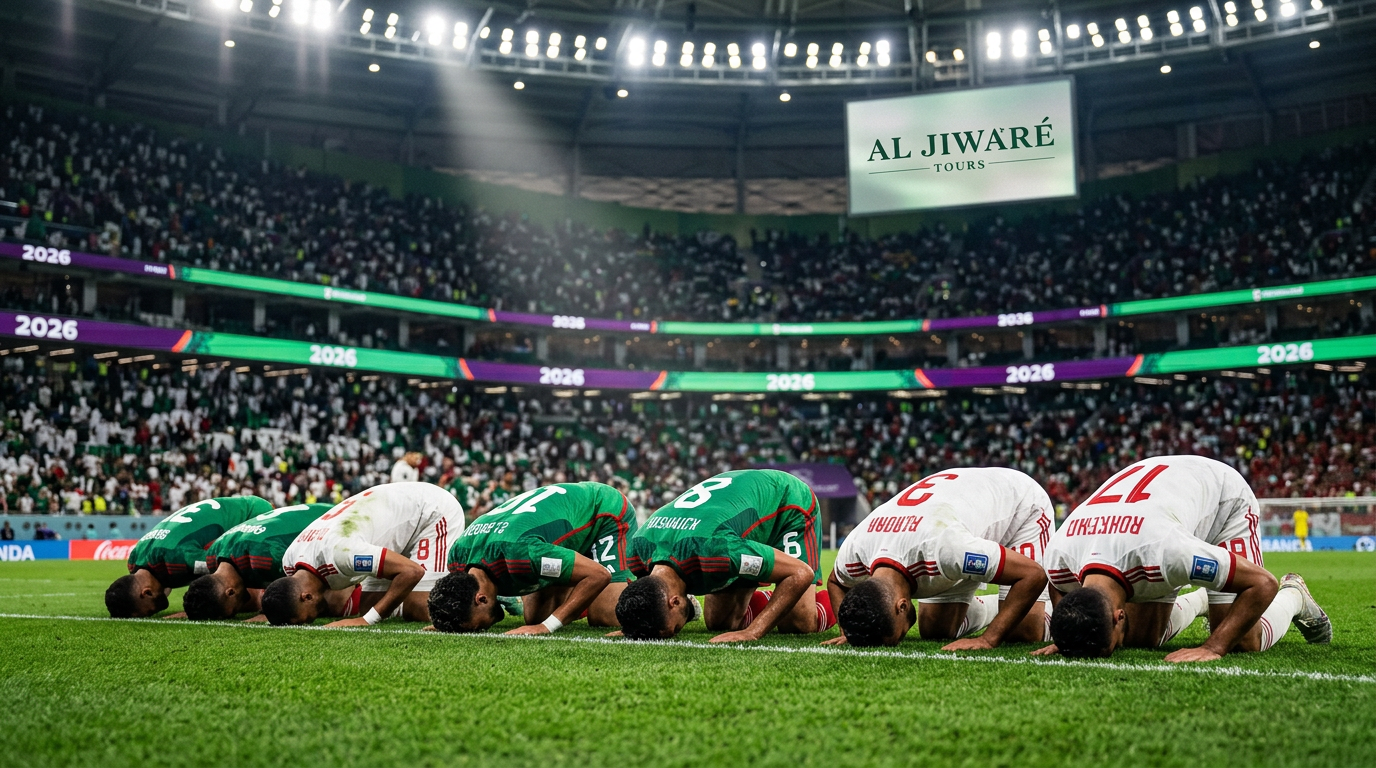
The Muslim stars of the 2026 World Cup—both the resilient converts who followed the light of truth and those who inherited their faith and carried it proudly before global lenses—have proved that bowing down on American grass is not a mere celebration. It is an open declaration of the soul's victory over material distractions, a silent message of peace traveling the earth and touching millions of hearts. Long after the final whistle of the 2026 World Cup fades, history will remember that behind the stunning goals and unforgettable victories, stood humble hearts that found their real peace in a simple prostration, a timeless pilgrimage, and absolute trust in the Lord of the Worlds.
Comments (0)
Login to comment on topics.
RegisterNo comments yet.