
Login to like or dislike this topic.
The Ultimate Guide to Religious Tourism: A Deep Dive into Egypt's Domestic Sacred Sites vs. International Pilgrimages (Saudi Arabia and Turkey as Models)
Chapter One: The Anthropology of Faith and the Human Impulse for Spiritual Journeys
1. The Sacred Geography and Identity Formation
Religious tourism has never been just a sub-sector of the global travel industry or a mechanical movement of vehicles; it is the physical manifestation of a deeply rooted human need—the impulse to step away from mundane, everyday life into spaces defined by holiness and grace. In the human psyche, and particularly within the Egyptian consciousness, geography is inextricably linked to divine blessings. A sacred landscape is viewed as living, tangible proof that anchors and revives faith. In the Nile Valley, this spiritual tradition traces back to the ancient Pharaohs, who sailed thousands of miles upstream in arduous river and land pilgrimages to Abydos, the cult center of Osiris, seeking spiritual solace, purification, and eternal life. This deep anthropological impulse did not vanish with the changing eras. Instead, it fluidly adapted to Coptic Christianity and Islam, transforming Egypt into a unique geographical nexus where spirituality is felt in every grain of sand.
When an individual travels to a sacred site, they are not merely covering physical distance; they are engaging in a detailed psychological ritual designed to rebuild the self and restore a soul worn down by modern materialism. The chaotic pace of contemporary life forces people to seek safe havens. This is where sacred geography steps in to offer spiritual sanctuaries. However, the response to this innate spiritual drive follows distinctly different geographical and economic pathways within the Egyptian market. Some find their healing peace in a historic neighborhood mosque or a monastery nestled in a nearby mountain cliff within their homeland. Others feel that complete spiritual fulfillment and the ultimate renewal of faith can only be achieved by crossing international borders, enduring the logistics of global travel to stand before Islam's primary Qibla in Mecca, or witnessing the grand imperial castles and Islamic heritage in legendary capitals like Istanbul and Konya.
2. The Psychology of Travel: Local Recreation vs. Transnational Compliance
A complex and highly sensitive psychology dictates the behavior of the religious traveler. In domestic religious tourism, pure devotional intent seamlessly blends with social bonding and affordable recreation. The domestic traveler in Egypt is often looking for a trip that reconnects them with both community and divine blessings. This is why annual festivals (Mawlids) and Christian spiritual revivals predominantly feature a family-centric, communal character. Entire families, neighborhood blocks, Sufi orders, or church congregations share a single bus. The journey quickly transforms into a warm, folklore-rich carnival where hymns and religious invocations blend with lively social chats and shared meals. It is a democratically accessible form of tourism that grants the individual peace of mind and blessings without breaking the bank, acting as a spiritual safety valve for the working and middle classes who view the shrines of saints as comforting, cost-free sanctuaries.
In stark contrast, the psychology of an international religious traveler undergoes a radical shift toward absolute spiritual discipline and strict compliance with rituals. Traveling for Hajj or Umrah, or embarking on a holy pilgrimage to Jerusalem, or even touring the grand Islamic monuments of Turkey, is viewed by the average citizen as a monumental, life-defining milestone—an event that may happen only once in a lifetime. Here, the casual, festive tone vanishes, replaced by profound humility, a noble existential anxiety regarding the acceptance of their rituals, and immense financial, psychological, and physical preparation. The traveler invests years of hard-earned savings into this journey, viewing every single minute spent in those holy lands as a direct investment in the afterlife. Furthermore, this travel grants the individual a elevated social status upon return, earning them the respected community title of "Hajj" or "Hajja," which carries connotations of trustworthiness, dignity, and moral integrity, demanding more disciplined ethical behavior in their daily lives.
Chapter Two: The Roadmap of Major Domestic Religious and Historical Sites in Egypt
1. The Islamic Legacy: Fatimid Cairo and Provincial Spiritual Hubs
Egypt, and particularly its capital Cairo—famed as the "City of a Thousand Minarets"—serves as the grandest repository of Islamic architectural and spiritual heritage in Africa and the Middle East. This legacy is profoundly anchored across the sacred shrines of the Prophet’s Household (Ahl al-Bayt) and the grand imperial sultanate mosques:
A) Shrines of Ahl al-Bayt: Guardians of Hearts and Destinations for Millions
- The Imam Hussein Mosque: Located in the vibrant heart of Fatimid Cairo, it stands as the primary spiritual destination for lovers of the Prophet’s Household in Egypt. The mosque houses the sacred shrine where the head of Imam Hussein ibn Ali ibn Abi Talib rests, attracting a continuous stream of visitors around the clock. The mosque and its surrounding historic alleys (Khan el-Khalili and Al-Gamaleya) have evolved into an interconnected spiritual and commercial hub, where moderate Sufi traditions thrive amidst the ambient scent of incense, musk, and centuries-old invocations.
- The Sayyida Zeinab Mosque: Revered in the Egyptian collective memory as the "Heroine of Bani Hashim" and the "Head of the Supreme Diwan." Following the tragedy of Karbala, Sayyida Zeinab chose Egypt as her final sanctuary, where the people welcomed her with tears and open arms. She blessed the country with her immortal prayer: "O people of Egypt, you have supported us, may God support you; you have sheltered us, may God shelter you." Her shrine in the Sayyida Zeinab district remains a vital center for domestic religious tourism, drawing millions seeking solace, especially during her massive annual festival.
- The Sayyida Nafisa Mosque: Known as "Nafisa of Knowledge," she was the great-granddaughter of Imam Hasan ibn Ali. Renowned for her asceticism, piety, and deep knowledge of Islamic jurisprudence and Hadith, she hosted intellectual circles attended by legendary scholars like Imam Al-Shafi'i. Her mosque and shrine sit along the historic "Darb al-Siba" (now the Sayyida Nafisa district), serving as a crucial anchor in the Ahl al-Bayt trail, which the Egyptian state has fully renovated, modernizing its plazas and connecting them with beautiful pedestrian walkways.
- Extended Ahl al-Bayt Shrines: The domestic map also includes the historic mosques and tombs of Sayyida Aisha (sister of Imam Al-Kazim), Sayyida Fatima al-Nabawiya (in the Darb al-Ahmar quarter), the shrine of the great Sufi master Ibn Ata Allah al-Iskandari, and the mausoleum of Imam Al-Shafi'i, which features the largest wooden dome covered in lead in Egypt, recently restored to reveal rare Ayyubid and Fatimid inscriptions.
B) Sultanate Mosques and Historic Beacons of Architecture
- Al-Azhar Mosque: Founded by General Jawhar al-Siqilli during the Fatimid conquest of Egypt in 972 AD, Al-Azhar evolved over the centuries from a local congregational mosque into a prestigious, world-renowned religious university—the oldest active institutional university in the Islamic world. Millions of tourists and scholars visit to admire its layered Fatimid, Mamluk, and Ottoman architecture, and to experience the historic classrooms that shaped moderate Islamic jurisprudence.
- The Amr ibn al-Aas Mosque: The very first mosque built on the African continent (in 641 AD) in the ancient city of Fustat following the Islamic conquest of Egypt. Known as the "Old Mosque" and the "Crown of Mosques," it recently underwent a comprehensive structural restoration that revived its original grandeur as a beacon of spiritual and historic heritage, seamlessly integrated with the massive Fustat Hills Park project.
- The Sultan Hassan and Al-Rifai Mosque Complex: Standing face-to-face in the Citadel square, the Mosque-Madrasa of Sultan Hassan represents the absolute pinnacle of Mamluk architecture globally. Western orientalists often describe it as the "Pyramid of Islamic Architecture" due to the colossal scale of its four soaring iwans and its brilliant geometric engineering. Right next to it stands the Al-Rifai Mosque, built in a neo-Mamluk style, housing the royal tombs of the Egyptian Royal Family (including Khedive Ismail and King Farouk) as well as the tomb of the late Shah of Iran, Mohammad Reza Pahlavi.
- The Ahmad ibn Tulon Mosque: Famed for its unique, external spiral minaret inspired by the Malwiya of Samarra in Iraq, it is the only mosque in Egypt whose architectural and structural features have remained completely unaltered since its construction in the Tulunid era (879 AD). It remains a premier destination for global architectural photographers and historical preservationists.
C) Provincial Capitals: Sufi Poles and Regional Sacred Landscapes
- The Al-Sayyed Ahmad al-Badawi Mosque (Tanta):** Dedicated to the great Sufi master and founder of the widely popular Badawiya order. His mosque in the heart of the Nile Delta acts as a massive center for domestic religious tourism throughout the year. Its annual festival (Mawlid) in October stands as the largest popular religious gathering in Egypt after the Hajj, drawing over two million visitors within a single week and heavily stimulating the economy of Tanta.
The Abul Abbas al-Mursi Mosque (Alexandria):** Perched in the coastal Anfoushi district, it is Alexandria’s most iconic mosque and architectural landmark. It houses the tomb of the Andalusian scholar Al-Mursi Abul Abbas, the principal disciple of the great Sufi master Abul Hasan al-Shadhili. The mosque is highly celebrated for its four distinct elevated domes and its beautiful Italian-Islamic architecture designed by the famous Italian architect Mario Rossi.The Al-Arif Billah Sidi Abdel-Rahim al-Qenawi Mosque (Qena): One of the most prominent Sufi poles in Upper Egypt, who migrated from North Africa to settle in the city of Qena to spread knowledge. His mosque and shrine serve as a massive anchor for religious travel in southern Egypt, welcoming hundreds of thousands of Upper Egyptians during annual celebratory seasons.Al-Bahnasa (The Oxyrhynchus of Islamic Egypt - Minya):** A historic village containing the resting places of over 5,000 companions of the Prophet and early Muslims who participated in the conquest of Egypt, including more than 70 veterans of the Battle of Badr. The area is currently undergoing a comprehensive state-backed archaeological and tourism development plan to transform it into a global religious landmark.
2. The Coptic Christian Legacy: The Holy Family Trail and Monastic Strongholds
Egypt possesses a unique Coptic Christian heritage that distinguishes it from all other nations on earth, defined by sheltering the child Jesus Christ and his virgin mother Mary during their historic flight from Judea, and by being the birthplace of Christian monasticism founded by Saint Anthony the Great and Saint Paul of Thebes in the Eastern Desert.
A) The Flight of the Holy Family Trail: The Grand National Tourism Project
This spiritual and historic trail extends for over 3,500 kilometers round-trip, crossing 8 Egyptian provinces from north to south. It has received profound presidential and governmental backing to develop it into a world-class tourism product, officially recognized and integrated into the Vatican's official pilgrimage itineraries:
- The Babylon Fortress and Coptic Cairo Complex: This historic area houses The Hanging Church, uniquely built over the bastions of the Roman Babylon Fortress without traditional ground pillars. Right next to it sits The Church of Abu Serga (Saint Sergius), which contains the ancient underground crypt where the Holy Family hid for three consecutive weeks. The complex also features the Church of St. George, the Coptic Museum, and the ancient Ben Ezra Synagogue, creating a beautiful visual and historical tapestry that embodies religious coexistence.
- The Virgin Mary Tree in El-Matariya: An ancient, blessed sycamore tree under which the Virgin Mary rested and where she washed the clothes of the infant Christ. According to heritage, the water poured there gave rise to the rare, fragrant balsam plant. The state has fully developed the site, converting it into a beautiful open-air museum for domestic and international travelers.
- The Monasteries of Wadi El-Natrun (Beheira): This historic desert depression shelters four active Coptic monasteries that rank among the oldest and most influential monastic strongholds globally: the Monastery of Saint Pishoy (housing his incorrupt body), the Syrian Monastery (famed for Saint Pishoy’s cave, the tree of Saint Ephrem the Syrian, and rare Syriac manuscripts), the Baramous Monastery, and the Monastery of Saint Macarius. These monasteries draw millions of visitors annually.
- The Monastery of the Virgin Mary at Jabal al-Tayr (Minya): Features a historic church carved directly into the solid rock by Queen Helena (mother of Emperor Constantine) in 328 AD at the exact location where the Holy Family stayed. It is also known as the "Monastery of the Palm" because tradition holds that the child Jesus stopped a falling boulder with his palm, leaving his print on the rock.
- Al-Muharraq and Deir Dronka Monasteries (Asiut): The Al-Muharraq Monastery at Qosqam is the most crucial and prolonged stop along the trail; the Holy Family lived there for nearly 6 months (185 days). The altar of its ancient church is recognized as the exact geographic center of Egypt, often referred to by Copts as the "Second Jerusalem." Meanwhile, Deir Dronka is carved into the western mountain of Asiut, welcoming over a quarter of a million pilgrims daily every August during the Feast of the Assumption.
B) The Red Sea Monasteries: The Cradle of Global Monasticism
- The Monastery of Saint Anthony: Nestled deep in the Eastern Desert at the foot of the South Galala mountain range, it is the very first Christian monastery established in the world, dating back to the 4th century AD. It features the famous cave of Saint Anthony, located 680 meters above sea level, which Coptic pilgrims and international tourists climb as a challenging yet deeply rewarding spiritual trek.
- The Monastery of Saint Paul: Located near Saint Anthony's monastery in a rugged mountain valley, it is built over the cave of Saint Paul the Anchorite (the first hermit in Christian history). The monastery houses rare ancient churches adorned with beautifully preserved, colorful Coptic frescoes, making it a key day-trip destination from Hurghada, Ain Sokhna, and Cairo.
3. South Sinai: The Holy Valley of Tuwa and the Great Transfiguration Project
- St. Catherine's Monastery: Perched at the foot of Mount Sinai (Mount Moses) in the rugged interior of South Sinai, this ancient Eastern Orthodox monastery is a registered UNESCO World Heritage site. It shelters the unique Burning Bush where God spoke to the Prophet Moses. It also houses the St. Catherine Monastery Library, which ranks second globally only to the Vatican in its collection of rare ancient manuscripts and codices. Uniquely, a Fatimid-era mosque stands inside its walls, built to protect the monks and the monastery across centuries.
- The Great Transfiguration Project: The Egyptian state is currently executing a massive, eco-friendly global development plan for the city of St. Catherine. The goal is to establish a world-class spiritual and meditative sanctuary that connects believers of the three Abrahamic religions, featuring luxury eco-lodges, an expanded international airport, and modern highway networks, all while strictly preserving the pristine historical and environmental landscape.
Chapter Three: The Sacred Geography of International Pilgrimages: The Two Holy Mosques (Mecca and Medina)
The Kingdom of Saudi Arabia holds the largest economic and spiritual weight in Egypt's international religious tourism market, driven by the core pillars and traditions of Islam. Mecca and Medina are the cradles of divine revelation and the absolute emotional centers of the global Muslim consciousness.
1. Mecca: The Cradle of Revelation and Center of the Earth
Religious travel to Mecca centers strictly around the Grand Mosque (Al-Masjid al-Haram) and the surrounding holy ritual sites, supported by some of the most advanced crowd-management infrastructure in the world.
A) Al-Masjid al-Haram and the Holy Kaaba
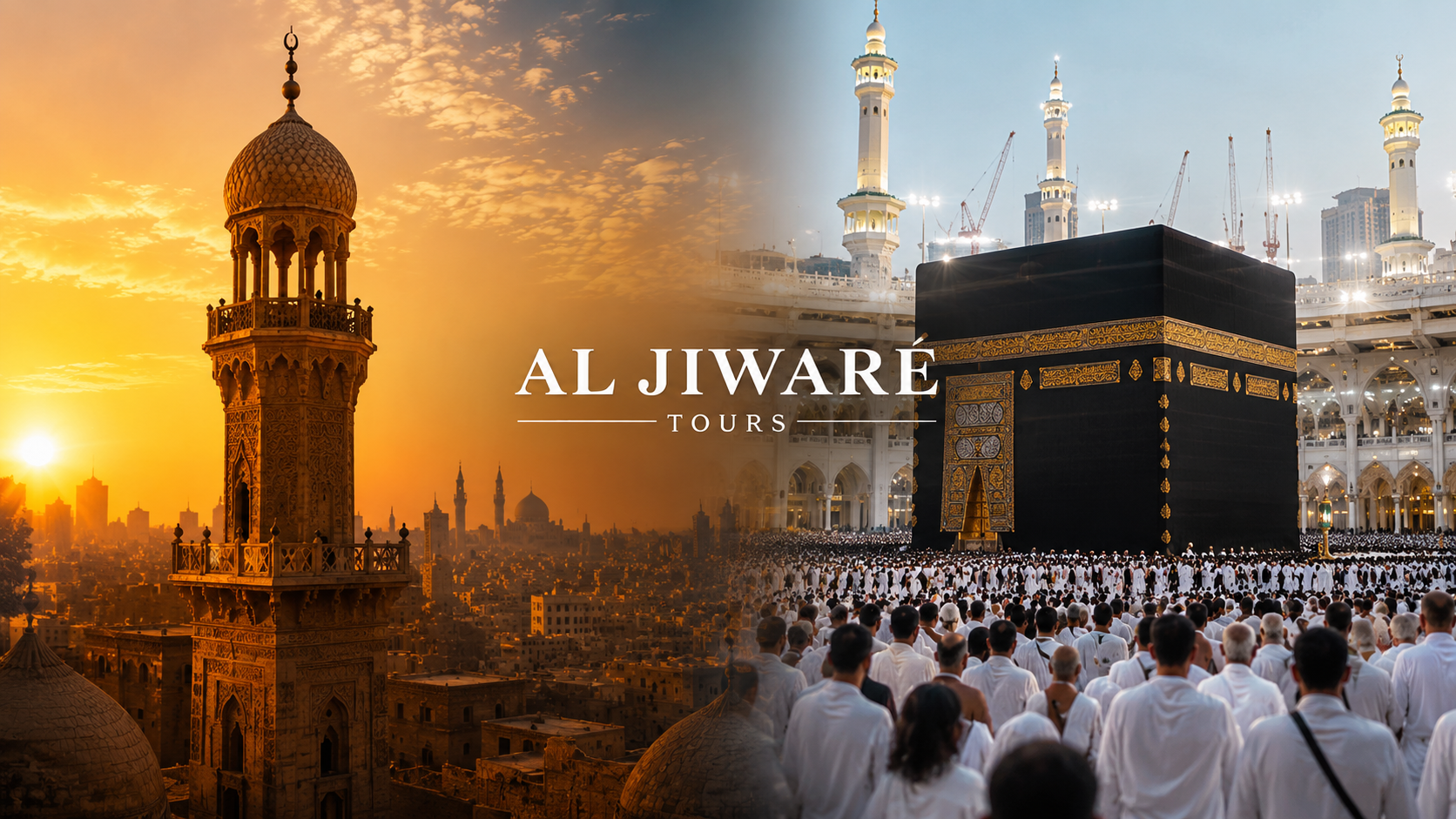
The holiest mosque in Islam, centering around the Holy Kaaba—the direction of prayer for Muslims worldwide. Massive consecutive Saudi expansions have multiplied the mosque's capacity to accommodate millions of worshippers and pilgrims simultaneously. The Grand Mosque houses pivotal sacred landmarks:
- The Black Stone and the Station of Abraham (Maqam Ibrahim): These mark the starting point of the circumambulation (Tawaf), where pilgrims pray their sunnah prayers, evoking the deep monotheistic history of Prophet Abraham.
- The Blessed Well of Zamzam: A miraculous spring of holy water that issued forth under the feet of the infant Ishmael. The authorities provide a highly advanced, automated distribution and filtration system that ensures cold, pure Zamzam water reaches every corner of the mosque.
- The Masa'a (Safas and Marwa): The expansive corridor where pilgrims walk and run seven times, re-enacting Hagar’s historic search for water. It is fully air-conditioned and built across multiple elevated floors equipped with dedicated lanes for the elderly and disabled to handle peak crowds.
B) The Holy Ritual Sites (Mashaer of Hajj)
These sites are tied directly to the annual Hajj packages (Siam, القرعة, and Associations) for Egyptians during the month of Dhu al-Hijjah:
- Mina: The largest tent city in the world, featuring modern, fire-resistant tents where pilgrims spend the days of Tashreeq and perform the stoning ritual at the multi-tiered Jamarat complex—a true marvel of crowd engineering.
- Mount Arafat: The Mount of Mercy and the ultimate legal core of the pilgrimage ("Hajj is Arafat"). Egyptian tourism companies coordinate heavily to provide fully air-conditioned, high-spec tents (German tents) to protect Egyptian pilgrims from extreme seasonal heat.
- Muzdalifah: The geographical station where pilgrims spend the night to gather pebbles after descending from Arafat, witnessing one of the largest coordinated bus-shuttle operations in the world.
C) Additional Historic Ziyarat Sites in Mecca
- Jabal al-Nour and the Hira Cave: The steep mountain housing the cave where the Prophet Muhammad ﷺ isolated himself for meditation and received the first verses of the Quran: "Read in the name of your Lord who created."
- Mount Thawr and the Thawr Cave: Where the Prophet ﷺ and his companion Abu Bakr hid from persecutors during their historic migration (Hijrah) from Mecca to Medina.
- The Al-Mu'alla Cemetery: An ancient burial ground housing the resting place of Sayyida Khadija bint Khuwaylid (the First Mother of the Believers) and the noble ancestors of the Prophet.
2. Medina: The Radiant City and the Sanctuary of Migration
Medina is characterized by a tranquil, serene, and profoundly peaceful spiritual aura that contrasts with the awe-inspiring majesty of Mecca. Travel here is an act of deep love, respect, and devotion to the Prophet ﷺ and his companions.
A) The Prophet’s Mosque (Al-Masjid an-Nabawi)
- The Rawdah ash-Sharifah: The holy space inside the mosque of which the Prophet ﷺ said: "Between my house and my pulpit lies a garden from the gardens of Paradise." Worshippers must book access through the strict automated "Nusuk" app to manage entry and prevent overcrowding, making it a priority for Egyptian travel agencies to secure slots for clients.
- The Green Dome and the Sacred Chamber: Where pilgrims stand with utmost reverence to offer greetings of peace to the Prophet ﷺ and his two closest companions and successive caliphs, Abu Bakr al-Siddiq and Umar ibn al-Khattab.
- The Smart Umbrellas and Plazas: Colossal automated umbrellas that open and close seamlessly to protect worshippers from the intense sun, equipped with misting fans that cool the arid desert air of Medina.
B) Historic Mosques and Relics in Medina
- The Quba Mosque: The very first mosque built in Islamic history upon the Prophet's arrival. Performing two rak'ahs of prayer inside it carries the spiritual reward of a full Umrah, making it a mandatory Saturday morning stop in travel itineraries.
- The Qiblatain Mosque (The Mosque of the Two Qiblas): The historical site where the direction of prayer was divinely shifted from the Al-Aqsa Mosque in Jerusalem to the Kaaba in Mecca mid-prayer.
- Mount Uhud and the Martyrs' Cemetery: Houses the resting place of the "Lion of God" Hamza ibn Abdel-Muttalib (the Prophet's uncle) and the companions who fell during the Battle of Uhud. Mount Uhud stands as a massive landmark famously loved by Muslims.
- The Al-Baqi Cemetery: The main burial ground adjacent to the Prophet's Mosque since his era, housing the sacred resting places of the Prophet’s Household, his wives (Mothers of the Believers), and thousands of early companions and saints.
Chapter Four: The Second Horizon of International Travel: Turkey (Fortresses of the Caliphate and Byzantine-Islamic Synthesis)
The Republic of Turkey has emerged in recent years as a major, highly favored historical and religious tourism destination for Egyptians and Arabs, brilliantly combining breathtaking natural landscapes, majestic Ottoman architecture, and a deeply layered Byzantine and Islamic history. It serves as the ideal model for "cultural religious tourism"—trips that focus on exploring civilizational history rather than strict devotional rituals.
1. Istanbul: The Capital of Empires and Bridge of Continents
Istanbul (ancient Constantinople) is the vibrant heart of this sector, recognizable by its iconic skyline dominated by slender, pencil-like minarets and cascading domes overlooking the Bosphorus strait:
A) The Hagia Sophia Grand Mosque: An Icon of Historic Transformations
Hagia Sophia is a legendary architectural and engineering masterpiece, built by Byzantine engineers in the 6th century AD (537 AD) as the grandest Greek Orthodox cathedral in the Eastern Roman Empire. It was converted into a congregational mosque following the conquest of Constantinople by the young Sultan Mehmed the Conqueror in 1453. After serving as a museum in the republican era, it was officially reinstated as an active, magnificent mosque open to all visitors. The interior design beautifully synthesizes gilded Byzantine Christian mosaics with colossal, circular Islamic calligraphy disks bearing the names of Allah, the Prophet, and the Rightly Guided Caliphs, making it the premier spiritual-historical landmark in the country.
B) The Sultan Ahmed Mosque (The Blue Mosque)
Positioned directly opposite Hagia Sophia across the historic Sultanahmet Square, it was built during the reign of Ottoman Sultan Ahmed I in the early 17th century to rival Hagia Sophia's grandeur. It is universally celebrated as the "Blue Mosque" because its interior walls and domes are completely covered in over 20,000 handmade, intricately detailed blue Iznik ceramic tiles. It is highly unique for featuring six soaring minarets, representing the absolute peak of classical Ottoman Islamic architecture blended with Byzantine engineering elements.
C) The Topkapi Palace and the Chamber of Holy Relics
Far from being just an ancient royal palace of administration, Topkapi is a major sacred sanctuary for Muslims; it houses the highly revered "Chamber of the Sacred Relics", which were transferred to Istanbul upon the transition of the Caliphate to the Ottomans. The chamber contains authentic personal belongings attributed to the Prophet Muhammad ﷺ (his sacred cloak, turban, a holy sandal, his bow, strands of his hair, and his battle banner), alongside the swords of the Rightly Guided Caliphs, an ancient staff attributed to the Prophet Moses, and early Quranic manuscripts written in Kufic script. Worshippers experience a deeply solemn atmosphere inside, where certified reciters chant the Holy Quran live 24 hours a day without interruption, a tradition kept alive for centuries.
D) The Eyup Sultan Mosque (The Sanctuary of Abu Ayyub al-Ansari)
Situated outside the ancient walls of Istanbul near the Golden Horn, it houses the sacred tomb of the great companion Khalid ibn Zayd (Abu Ayyub al-Ansari), who famously hosted the Prophet ﷺ in his home in Medina during the Hijrah, and fell a martyr at the walls of Constantinople during its first historic siege in the Umayyad era. This mosque holds immense sanctity for Turks and visiting Arabs alike; it historic hosted the solemn "Girding of the Sword" (the Sword of Osman) ritual for new Ottoman Sultans upon ascending the throne—the official imperial coronation ceremony.
2. Konya: The Cradle of Philosophical Sufism and Rumi's Divine Love
Located in the heart of the Anatolian plateau, Konya serves as the spiritual capital of philosophical and poetic Sufism in Turkey:
- The Mevlana Museum and Mausoleum of Jalal al-Din al-Rumi: The legendary founder of the Mevlevi Sufi order and author of the world-famous "Masnavi"—a masterpiece of divine love and human tolerance. The sanctuary houses his tomb alongside those of his family and closest disciples, instantly recognizable by its iconic conical green dome. It draws millions of Western and Eastern tourists annually, peaking during the "Seb-i Arus" (Night of Union) festival in December, where visitors gather to witness the spellbinding Whirling Dervishes ceremony (Sema), which symbolizes the soul's ecstatic ascent toward the Creator.
3. Bursa: The First Ottoman Capital and Early Architectural Heritage
- The Grand Mosque of Bursa (Ulu Cami): Located at the foot of Mount Uludag in the first Ottoman capital, Bursa, it was completed under Sultan Bayezid I at the end of the 14th century. It features 20 massive domes arranged in a grand grid. Uniquely, a magnificent marble fountain (Shadirvan) sits directly inside the center of the prayer hall beneath an open skylight dome that floods the space with natural light. The mosque also displays 192 breathtaking calligraphic wall inscriptions executed by the finest Ottoman masters, alongside the historic, gold-embroidered door curtain of the Kaaba brought by Sultan Selim I after the conquest of Egypt in 1517.
Chapter Five: Comparative Economic Analysis and the Flow of Tourism Capital
Religious tourism is not merely an expression of faith and psychological peace; it is a massive global industry that directly impacts the balance of payments, monetary policies, and national employment. This chapter breaks down the spending mechanisms and currency dynamics across domestic and international channels.
1. The Financial Equations of International Travel: The Foreign Currency Challenge
International religious tourism, particularly to Saudi Arabia for Hajj and Umrah, represents a primary and consistent source of foreign exchange consumption in Egypt. This is driven by a rigid cost structure where almost all core components must be settled in foreign currencies (Saudi Riyals or US Dollars):
A) The Cost Structure for International Travelers
An international pilgrimage package consists of critical cost elements that must be paid in foreign currency, prompting agencies to develop flexible options for the wider population. In this regard, companies heavily compete to design affordable Umrah packages in Egypt that strike a balance between reasonable pricing and reliable services, covering sovereign fees, platform insurance, and accommodation in central Mecca and Medina hotels near the Harams.
During periods when Egypt faces fluctuations in foreign currency reserves, the prices of these international packages are directly affected. This prompts the Egyptian Ministry of Tourism and the Central Bank to apply restrictive regulatory policies to protect the national economy—such as enforcing strict numerical quotas for each travel agency per season, or applying regulatory fees to temper the outflow of foreign cash. This continually encourages the market toward affordable options or land and sea routes that require significantly less foreign currency. Meanwhile, cultural religious travel to Turkey falls under standard international leisure budgets, determined by global aviation pricing, currency exchange rates, and entry visa fees.
2. The Circular Economy of Domestic Tourism: Revitalizing Regional Provinces
In total contrast to currency-consuming international travel, domestic religious tourism operates as an "effective tool for generating a circular economy and redistributing national wealth locally". Capital originates and accumulates in wealthy, highly liquid metropolitan centers (like Cairo, Giza, and Alexandria) and flows via bus and rail networks directly into lower-income, developing regional provinces (such as the villages of Minya, Asiut, Beheira, Gharbia, and the holy valleys of Sinai).
- Revitalizing Informal Labor Sectors and Micro-Enterprises: The millions of citizens who flock to the annual festival of Al-Sayyed Al-Badawi in Tanta or the monasteries of Wadi El-Natrun, Jabal al-Tayr, and Deir Dronka do not spend their money at multinational hotel chains. Instead, their spending goes directly into the pockets of local, everyday working families, benefiting bus and microbus drivers, sellers of traditional heritage goods (chickpeas, sweets, rosaries, incense, Coptic icons, and handmade crafts), and seasonal workers managing stalls and food kitchens.
- Protecting Household Financial Stability: Because all transactions in domestic tourism are settled entirely in Egyptian Pounds, this sector remains shielded from global currency fluctuations and international inflation. It maintains a steady annual growth rate, capitalizing on an affordable per-person cost that makes single-day trips (Day-use) accessible to all segments of Egyptian society.
Chapter Six: Logistics, Infrastructure, and Crowd Management Systems
Managing the flow of millions of people toward historic and religious destinations during compressed seasonal windows requires a rock-solid legislative framework and strict logistical oversight to eliminate fraud, ensure crowd safety, and maintain public health.
1. Tight Digital and Regulatory Ecosystems in International Travel
Technology and digital booking platforms have become the absolute rulers of the international religious tourism sector in both Egypt and Saudi Arabia, securing the rights of all involved parties:
- The Egyptian Umrah Portal and Law No. 72 of 2021: An integrated digital regulatory network that directly links the Egyptian Ministry of Tourism with all national airports and border checkpoints. Under this law, no Egyptian citizen can pass through airport passport control for Umrah unless they carry an active, officially verified digital "Barcode" issued by the portal. This barcode proves they are traveling through a licensed agency with a verified itinerary, valid hotel accommodation, return flights, and approved medical insurance, effectively wiping out unauthorized middlemen and fraudulent operators.
- Saudi Digital Transformation and "Nusuk" Platforms: The Kingdom of Saudi Arabia has shifted its Hajj and Umrah infrastructure entirely to digital apps. Pilgrims secure visas, prayer permits for the Rawdah ash-Sharifah, and dedicated Tawaf time slots through smart applications linked to biometric data. This requires Egyptian travel agencies to maintain highly trained digital teams to manage client bookings second by second, ensuring no permits are lost in the holy lands.
2. Comprehensive Logistical and Security Overhauls in Domestic Tourism
Egypt has executed its largest-ever infrastructure and logistical overhaul of local religious and historical landmarks to facilitate and secure tourism movements:
- Modern Pedestrian Walkways for Ahl al-Bayt Shrines: The state has completely repaved, landscaped, and redesigned the historic streets connecting the mosques and shrines of Sayyida Nafisa, Sayyida Ruqayya, and Sayyida Zeinab. It created beautiful pedestrian paths fitted with heritage lighting and unified kiosks for local vendors, while deploying fleets of small electric vehicles (taftaf) to transport the elderly and families between shrines free of charge.
- Advanced Crowd Management during Mass Festivals: The Ministry of Interior coordinates closely with the Ministry of Endowments and the Coptic Church to establish secure security perimeters, electronic metal detectors, and completely separate entry and exit lanes during major annual festivals (such as the Feast of St. George in Luxor, the Dronka celebrations in Asiut, or the Badawi festival in Tanta), while deploying hundreds of ambulances and mobile field hospitals to ensure public safety.
Chapter Seven: Digital Marketing and SEO Strategies for Professional Travel Agencies
In today's digital era, customers no longer look for travel agencies through printed directories or traditional television commercials; search engines—led by Google—have become the absolute first consultant for citizens before making a travel decision. To successfully capture the Egyptian and Arab client, travel companies must craft a highly intelligent digital content strategy that clearly separates "Commercial Purchase Intent" from "Informational Exploration Intent."
1. Keyword Architecture and Search Engine Optimization
Targeted keywords on a travel website must be strategically mapped according to the user's financial and mental mindset (User Journey):
A) Commercial Intent Keywords - For International Travel
These target users who possess the budget and are ready to book a trip immediately, characterized by fierce search engine competition and requiring paid search advertising (PPC) budgets:
- Affordable Umrah packages in Egypt this year
- Hajj tourism package pricing and booking
- Turkey tourist visa for Egyptians requirements
- How to get the Egyptian Umrah Portal barcode
- 5-star Mecca hotels overlooking the Haram
B) Informational and Geographical Keywords - For Domestic and Cultural Travel
These target building brand awareness and driving massive, sustainable free traffic (Organic Traffic) to the website by providing long-form, highly detailed educational guides:
- Complete guide to visiting the Holy Family Trail in Egypt
- History of Hagia Sophia Grand Mosque conversion
- Where is the tomb of Abu Ayyub al-Ansari in Istanbul located
- Opening hours of the Church of the Holy Sepulchre for Copts
- Best time to climb Mount Sinai and visit St. Catherine in winter
2. Implementing E-E-A-T Criteria (Experience, Expertise, Authoritativeness, and Trustworthiness)
Google’s recent core algorithm updates place utmost, decisive importance on websites that offer highly reliable content in sectors that directly impact users' financial stability, safety, and health, classified under the (YMYL - Your Money or Your Life) umbrella. The religious tourism sector sits right at the heart of this sensitive category because trips involve investing life savings and relate to the physical safety of travelers at home and abroad.
- Prominently Displaying Official Licenses and Credentials: A travel agency's website must clearly display its official license number issued by the Egyptian Ministry of Tourism, the Chamber of Travel Agencies emblem, and direct links to the official Umrah Portal within the website footer across all pages to build immediate trust with Google Crawlers and human users alike.
- Providing Accurate and Deep Educational and Ritual Content: The websites that dominate SEO results are those that present comprehensive, religiously verified, and highly accurate step-by-step ritual guides (such as: "The Ultimate Guide to Performing Umrah from Ihram to Tahallul with Photos and Videos") written in clear, accessible language, which naturally increases user time on page (Dwell Time) and slashes bounce rates.
- Rich Visual and Practical Guides for Domestic Travel: Readers searching for domestic trips run away from dry, rigid text. They want to see precise interactive maps, high-quality authentic photos of monastery guesthouses or historic mosque courtyards, and highly practical tips regarding local transport and clothing (such as the absolute necessity of heavy winter gear when climbing Mount Sinai at night). Frequently updating this content ensures long-term dominance in local search results.
Chapter Eight: Operational Budgets and Detailed Logistical Differences Between Land, Sea, and Air Routes
To provide a highly professional operational perspective that serves travel agencies in designing packages and marketing them to clients, we must deconstruct the transport mechanisms that serve as the true foundation for pricing and executing international vs. domestic religious travel.
1. Air Logistics (Direct Flights, Charters, and Transit Routes)
Luxury and premium international packages (first-row hotels directly facing the Harams) and 5-star Hajj tourism programs rely heavily on aviation as their core transport component.
Logistically, air travel offers rapid speed, preserves the physical health of the elderly and sick, and provides direct access to Prince Mohammad bin Abdulaziz International Airport in Medina or the Hajj Terminal at King Abdulaziz International Airport in Jeddah. However, economic and operational challenges persist, as ticket prices are subject to highly flexible and aggressive seasonal pricing by national and private carriers, doubling or tripling during peak seasons (such as the last ten days of Ramadan and the Hajj season), which heavily inflates total package costs. Recently, agencies have increasingly turned to transit flights via other Arab capitals to reduce costs for budget-conscious clients. In contrast, domestic aviation in Egypt remains anchored under stable, locally currency-priced frameworks, representing only a minor fraction of the domestic market, which relies 95% on land networks.
2. International and Domestic Land Logistics (High-Spec International Luxury Coaches)
Land-based Hajj and Umrah packages represent the true economic and operational backbone for the Egyptian middle and working classes wishing to travel to the holy lands, as they successfully shave off 35% to 50% of the cost of international flight tickets. The geographical route for international land travel is a fascinating and detailed journey: buses launch from various Egyptian provinces, heading directly to the Nuweiba sea port in South Sinai, where the luxury coaches board massive marine ferries to cross the Gulf of Aqaba to the Jordanian port of Aqaba. From there, the coaches travel across the entire length of Jordanian territory by land, arriving at the Halat Ammar border crossing on the northern frontier of Saudi Arabia, and from there proceeding directly to Medina or Mecca in an arduous yet deeply moving journey lasting 36 to 48 hours of continuous travel.
3. Marine Logistics (Shipping Lines and Ferries across the Red Sea)
Marine logistics serve as an essential and mandatory geographical link for land travel crossing the Gulf of Aqaba, or function as independent marine voyage programs launching entirely via the Egyptian Safaga port on the Red Sea to the Saudi port of Dhiba. This maritime model requires high-level advance coordination between ports, maritime safety authorities, and passport control to manage, organize, and digitize the movement of mass crowds, while preparing fully air-conditioned departure lounges and securing comprehensive medical and preventive care for Egyptian pilgrims during waiting or sailing periods across the Red Sea.
Chapter Nine: The Crucial Role of Spiritual Guidance and Cultural Curation in Travel Success
A religious or historical travel package cannot be truly successful or fulfill its deep emotional purpose by simply providing a comfortable central hotel and a modern air-conditioned coach; the true value-add and the core anchor that builds a travel agency’s sustainable commercial reputation lies entirely in the expertise and capability of the accompanying spiritual guide or the specialized historical curator.
No religious or historical travel package can truly fulfill its profound emotional purpose through comfortable hotels and air-conditioned coaches alone; the true value-add and the core pillar that builds a travel agency's sustainable commercial reputation lies entirely in the capability of the accompanying spiritual guide. Prior to departure, trusted agencies ensure they deliver comprehensive orientations to travelers, such as providing a detailed step-by-step Umrah rituals guide to simplify the jurisprudence steps from intentions and Ihram to completion, granting the traveler absolute peace of mind that their worship is accurate and complete.
1. The Spiritual Guide in International Pilgrimages
The religious guide accompanies each tour group, explaining the rituals of Umrah and Hajj with precise jurisprudential detail through intensive seminars held in Egypt before departure, and guiding them step-by-step at the Miqat, while providing immediate answers to critical jurisprudential questions that arise during Tawaf around the Kaaba, Sa'i between Safa and Marwa, and the standing at Arafat, granting the traveler absolute peace of mind that their worship is correct and accepted.
2. The Specialized Historical Curator in Domestic Tours
In the domestic religious tourism sector in Egypt, the role of a certified historical guide beautifully synthesizes with the spiritual essence of the site to create an unforgettable educational experience. A skilled curator is the one who narrates the human story behind the physical monument: the structural challenges, the turbulent historical and political events the site witnessed, and the unique architectural and engineering genius with which it was built (such as the brilliant acoustics and sound-echo distribution within the soaring iwans of the Sultan Hassan Mosque, or the structural method of suspending the Hanging Church over the high bastions of the ancient Roman Babylon Fortress without traditional ground foundations).
Chapter Ten: Sustainable Development and Future Horizons of Spiritual Travel
Closing this comprehensive encyclopedic study requires an analytical, forward-looking look built on the foundations of sustainable development and Egypt’s economic vision, mapping where this vital market is heading and how travel companies and investors can prepare for upcoming shifts in religious consumer behavior.
1. Digitizing the Spiritual Journey and the Rise of "Smart Tourism"
The future of religious tourism is moving at lightning speed toward total digitalization and artificial intelligence integration. Internationally, we have witnessed how visas and booking platforms have transformed into fully biometric digital ecosystems, and in the near future, we will see the integration of Augmented Reality (AR) and Virtual Reality (VR) technologies in package marketing. Travel agencies will be able to let a client experience their hotel room in Mecca, walk inside the Hagia Sophia Grand Mosque in Istanbul, or tour the ancient Holy Family crypt in Coptic Cairo via VR glasses right from the agency's office in Cairo before paying a single pound.
2. Green Tourism and Eco-Friendly Spiritual Travel (Eco-Religious Tourism)
With escalating global climate challenges, a new generation of younger religious travelers is actively seeking "sustainable and green religious journeys" that minimize environmental impact. This shift is perfectly embodied in the "Great Transfiguration" project in St. Catherine, Egypt, which is built entirely to strict environmental codes using local materials, clean solar energy, water recycling systems, and restricting polluting vehicles near the ancient archaeological perimeter. Similarly, authorities in Mecca and Medina are executing "Green Hajj" initiatives to eliminate plastic waste and utilize high-speed electric trains instead of thousands of diesel buses. Smart travel agencies must design marketing programs highlighting the environmental and sustainable aspects of their trips to capture this rapidly growing demographic.
Conclusion: Spiritual Harmony and National Economic Stability
At the conclusion of this extensive encyclopedic guide, we arrive at a fundamental and unchanging truth: religious tourism across all its geographical dimensions remains the most powerful emotional and spiritual driver for human hearts and minds throughout long human history. As demonstrated by the data and analysis within the preceding chapters, the relationship between domestic religious tourism in Egypt and major international destinations like Saudi Arabia and Turkey is by no means a relationship of contradiction or negative economic competition; rather, it is a harmonious, complementary ecosystem that beautifully fulfills the layered and diverse needs of the human soul across varying financial and physical circumstances.
While Mecca and Medina remain the greatest longing, the ultimate direction of prayer, and the mandatory spiritual call that represents the bedrock of Islamic pillars for the entire Muslim world, and while Turkey stands as the living museum showcasing the architectural majesty of Islamic civilization and its unique synthesis with Byzantine and European heritage, domestic religious tourism in Egypt shines as the ultimate fortress and the daily social-spiritual safety valve protecting the country's ancient historical identity. It provides rich devotional, cultural, and recreational alternatives that are deeply impactful and financially accessible to all segments of Egyptian society without placing any strain on the national economy or the balance of payments. On the contrary, it actively injects millions into regional development, revitalizing distant provinces in Upper Egypt, Sinai, and the Nile Delta.
The smart, professional investment for travel agencies and the Egyptian state in the future lies in maximizing the returns of the massive national infrastructure and presidential mega-projects to revitalize and export domestic religious tourism—attracting millions of international and local tourists and injecting foreign currency into the country—in parallel with delivering highly innovative, digitally streamlined, and safe international travel packages that ensure Egyptian citizens perform their sacred rituals, Hajj, Umrah, and pilgrimages abroad with the highest levels of human dignity, health safety, and spiritual comfort, all under the protective legal umbrella of the state's digital platforms that shield the citizen from fraud and shield the national economy from volatility. Egypt will remain, as it has always been across centuries and timelines, a blessed, secure land radiating spirituality and tolerance, welcoming with an open heart and guarding eyes every seeker of peace, blessings, knowledge, and reflection, whether within its historic local borders or crossing its skies toward the pure horizons of the heavens in the holiest spots on earth.
Comments (0)
Login to comment on topics.
RegisterNo comments yet.